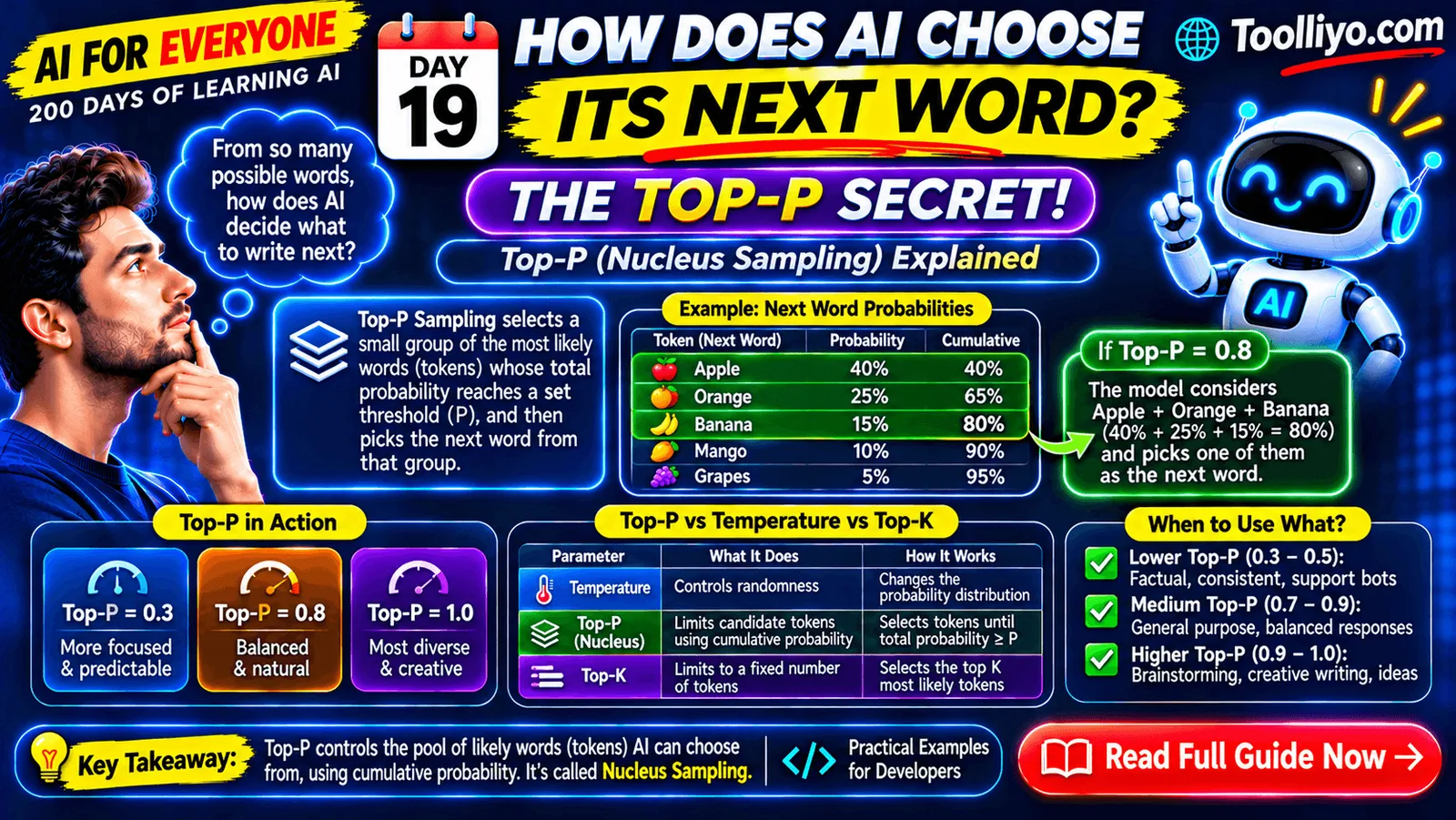
AI for Everyone — 200 Days of Learning AI | Day 19
When you ask an AI assistant a question, have you ever wondered how it decides which word comes next?
For example, imagine entering this prompt:
"Artificial Intelligence is transforming the..."
The AI model might predict several possible next tokens:
-
World
-
Healthcare
-
Business
-
Technology
-
Education
But how does it decide which token to select?
Does it consider every possible token? Does it always choose the token with the highest probability?
Not necessarily.
Many language models use sampling techniques to select the next token. One important technique is Top-P Sampling, also called Nucleus Sampling.
Top-P controls the group of candidate tokens from which the model samples its next token.
In this guide, we'll understand Top-P from the beginning, explore numerical examples, compare it with Temperature and Top-K, and learn how developers can use it in AI applications.
1. What Is Top-P Sampling?
Top-P Sampling is a token-selection technique used during language generation.
It selects a group of the most probable candidate tokens whose cumulative probability reaches a specified threshold, P.
This group is called the nucleus.
The model then samples the next token from that candidate group, using the probabilities normalized within the selected group.
Simple definition:
Top-P Sampling controls which likely tokens are eligible to be selected when an AI model generates the next token.
For example:
If Top-P is 0.9, the model selects the smallest group of highest-probability tokens whose cumulative probability reaches or exceeds 90%.
It does not simply select the top 90% of all available tokens.
That distinction is important.
2. First, Understand Token Probability
Before understanding Top-P, let's understand how language models predict tokens.
An LLM generates text one token at a time.
A token can be:
-
A complete word.
-
Part of a word.
-
A punctuation mark.
-
A number.
-
A space or other text unit, depending on the tokenizer.
Imagine the model receives:
"Today the weather is..."
It might produce the following illustrative probability distribution:
| Candidate token | Probability |
|---|---|
| Sunny | 40% |
| Cloudy | 25% |
| Rainy | 15% |
| Beautiful | 10% |
| Other | 10% |
These probabilities represent the model's predicted distribution for the next token in this simplified example.
The model can use a sampling strategy to select a token from the distribution.
Top-P helps determine which candidates remain eligible.
3. How Does Top-P Sampling Work?
Let's understand the process step by step.
Suppose an AI model generates these next-token probabilities:
| Token | Probability | Cumulative probability |
|---|---|---|
| Apple | 40% | 40% |
| Orange | 25% | 65% |
| Banana | 15% | 80% |
| Mango | 10% | 90% |
| Grapes | 5% | 95% |
| Other | 5% | 100% |
Now suppose Top-P is set to 0.8.
The model selects the smallest group of highest-probability tokens whose cumulative probability reaches or exceeds 80%.
The selected group is:
-
Apple: 40%
-
Orange: 25%
-
Banana: 15%
Total = 80%.
The remaining candidates are excluded from this sampling step.
The probabilities inside the selected group are then renormalized:
| Token | Original probability | Probability after renormalization |
|---|---|---|
| Apple | 40% | 50% |
| Orange | 25% | 31.25% |
| Banana | 15% | 18.75% |
The model samples from this reduced distribution.
It may select Apple, Orange, or Banana.
It does not always select Apple.
Important: This example assumes the tokens are already sorted by probability and uses a simplified sampling distribution. Actual generation systems can combine Top-P with temperature and other decoding rules.
4. What Happens at Different Top-P Values?
Let's compare three illustrative settings.
Top-P = 0.5
The model considers a relatively small group of high-probability candidates.
Using our earlier example:
-
Apple: 40%
-
Orange: 25%
The cumulative probability reaches 65%, so the selected group includes both tokens.
The group is relatively narrow.
This can reduce the diversity of possible next-token selections.
Top-P = 0.9
The model includes:
-
Apple: 40%
-
Orange: 25%
-
Banana: 15%
-
Mango: 10%
Cumulative probability = 90%.
The model has a wider group of candidates available.
Top-P = 1.0
All tokens in the probability distribution are eligible, subject to any other sampling constraints.
The model is no longer restricting the candidates using a nucleus threshold below 1.
However, it does not mean the model chooses all tokens equally.
The original probability distribution still matters.
Key takeaway: Lower Top-P generally restricts the candidate pool. Higher Top-P allows a broader pool of possible tokens.
5. What Is Nucleus Sampling?
Top-P Sampling is also known as Nucleus Sampling.
Why?
Because the algorithm selects a nucleus: the smallest set of high-probability tokens whose cumulative probability reaches the specified threshold.
Think of it this way:
Imagine 10,000 possible tokens are available.
Only a small number may have meaningful probability for the current context.
Top-P identifies a group of likely candidates and excludes the long tail of less probable alternatives.
This makes sampling more adaptive than selecting a fixed number of tokens.
For example:
If a model has only a few highly probable next tokens, the nucleus may be small.
If the probability distribution is more spread out, the nucleus may contain more tokens.
This is one reason Top-P is different from Top-K sampling.
6. What Is the Difference Between Top-P and Temperature?
We studied Temperature in Day 18.
Both parameters influence the generation process, but they perform different functions.
Temperature
Temperature changes the shape of the probability distribution.
-
Lower temperature makes higher-probability tokens more dominant.
-
Higher temperature makes alternative tokens relatively more likely.
Top-P
Top-P determines the candidate group based on cumulative probability.
-
Lower Top-P generally creates a smaller candidate group.
-
Higher Top-P generally allows a broader candidate group.
Comparison
| Feature | Temperature | Top-P |
|---|---|---|
| Main purpose | Adjusts probability distribution | Filters candidate tokens |
| Controls | Distribution sharpness | Cumulative probability threshold |
| Lower setting | More concentrated probabilities | Smaller candidate pool |
| Higher setting | More varied probability distribution | Larger candidate pool |
| Also known as | Temperature scaling | Nucleus Sampling |
Simple way to remember:
Temperature changes the probability distribution.
Top-P decides how much of that distribution remains eligible for sampling.
Some APIs let you configure both. Others may restrict their use or recommend adjusting one at a time.
Always check the model provider's documentation.
7. What Is Top-K Sampling?
Another important technique is Top-K Sampling.
Top-K restricts token selection to the K highest-probability candidates.
For example:
Suppose the model predicts:
| Token | Probability |
|---|---|
| Apple | 40% |
| Orange | 25% |
| Banana | 15% |
| Mango | 10% |
| Grapes | 5% |
| Other | 5% |
If Top-K = 3, only these three candidates remain:
-
Apple
-
Orange
-
Banana
The model samples from those candidates after renormalizing their probabilities.
Top-K vs. Top-P
| Feature | Top-K | Top-P |
|---|---|---|
| Selection method | Fixed number of candidates | Cumulative probability threshold |
| Example | K = 3 | P = 0.8 |
| Candidate count | Fixed by K | Can change by context |
| Main idea | Select top K tokens | Select the probability nucleus |
Top-K uses a fixed candidate count.
Top-P uses an adaptive candidate group based on the current probability distribution.
Some model providers support both, while others expose only one or neither.
8. Practical Example: Same Prompt, Different Top-P
Let's imagine you're building an AI application that generates startup names.
Prompt:
"Suggest a name for an AI-powered developer productivity platform."
Lower Top-P
With a narrower candidate pool, the output may favor more conventional and predictable word choices.
Illustrative names:
-
DevAssist
-
CodeFlow
-
DeveloperHub
-
CodeHelper
-
DevTools
Higher Top-P
With a broader candidate pool, more alternatives may become available.
Illustrative names:
-
NeuralForge
-
BytePilot
-
CodeOrbit
-
SyntaxNova
-
QuantumCraft
These are illustrative examples, not guaranteed outputs at specific Top-P settings.
The actual result depends on the model, prompt, temperature, and other generation settings.
9. Where Is Top-P Used in Real Applications?
Top-P is relevant to many AI-powered products.
1. AI Chatbots
A chatbot may use generation settings that balance response variety with predictable behavior.
For customer support, factual grounding and validation matter more than simply choosing a low Top-P.
2. Content Generation
An AI writing assistant can use sampling configurations to generate alternative headlines, introductions, and descriptions.
3. AI Coding Assistants
Coding tools can use model-specific decoding settings to influence code generation.
Generated code still needs compilation, testing, and review.
4. AI Agents
AI agents may use LLMs for planning, summarization, and natural-language interaction.
For structured actions, the application should enforce schemas and validate tool arguments rather than relying on sampling settings.
5. Creative Applications
Story generation, brainstorming, and creative writing may benefit from configurations that allow more diverse candidate tokens.
The correct configuration depends on the model and desired output.
10. How Developers Configure Top-P in LLM APIs
Let's look at a simplified API request.
Many chat-completion-style APIs expose a parameter named top_p.
Example:
{
  "model": "your-supported-model",
  "messages": [
    {
      "role": "user",
      "content": "Suggest five AI startup ideas."
    }
  ],
  "top_p": 0.9
}
This is an illustrative request format.
The exact endpoint, request structure, supported models, and parameter constraints depend on the provider.
Example: Node.js
const response = await fetch(
  "YOUR_LLM_API_ENDPOINT",
  {
    method: "POST",
    headers: {
      "Content-Type": "application/json",
      "Authorization": `Bearer ${process.env.AI_API_KEY}`
    },
    body: JSON.stringify({
      model: "your-supported-model",
      messages: [
        {
          role: "user",
          content: "Suggest five AI startup ideas."
        }
      ],
      top_p: 0.9
    })
  }
);

if (!response.ok) {
  throw new Error("AI API request failed");
}

const result = await response.json();

console.log(result);
Example: ASP.NET Core
You can define a configuration class:
public class AiGenerationOptions
{
    public string Model { get; set; } = string.Empty;

    public double TopP { get; set; } = 0.9;

    public int MaxOutputTokens { get; set; } = 1000;
}
Register the options:
builder.Services.Configure<AiGenerationOptions>(
    builder.Configuration.GetSection("AI"));
Example configuration:
{
  "AI": {
    "Model": "your-supported-model",
    "TopP": 0.9,
    "MaxOutputTokens": 1000
  }
}
Your AI service should map these settings to the provider's actual API request.
Validate supported values, handle provider errors, and avoid hardcoding API credentials.
11. Common Mistakes When Using Top-P
Mistake 1: Assuming Top-P controls creativity directly
Top-P controls the candidate token pool. It does not directly measure creativity.
Mistake 2: Assuming Top-P = 1 means deterministic output
It does not. It allows the full probability distribution to remain eligible, subject to other sampling rules.
Mistake 3: Confusing Top-P with Top-K
Top-K uses a fixed number of candidates.
Top-P uses cumulative probability.
Mistake 4: Changing Temperature and Top-P together
When experimenting, change one parameter at a time where possible.
This helps you understand which setting caused a change.
Mistake 5: Assuming low Top-P eliminates hallucinations
It does not.
An AI model can generate incorrect information even with a narrow candidate pool.
Use trusted data, grounding, verification, and evaluation.
Mistake 6: Ignoring model-provider differences
Not every model supports Top-P, and supported ranges or behavior may differ.
Always consult the provider's documentation.
12. Practical Challenge: Experiment With Top-P
Try this experiment using a model API or playground that supports Top-P.
Use the same prompt:
"Suggest 10 unique AI-powered SaaS ideas for small businesses."
Test these settings, if supported:
-
Top-P = 0.3
-
Top-P = 0.5
-
Top-P = 0.8
-
Top-P = 1.0
Record:
| Setting | What to observe |
|---|---|
| 0.3 | Does the output become more predictable? |
| 0.5 | Are the candidate choices more restricted? |
| 0.8 | Does the output offer more variation? |
| 1.0 | Does the broader candidate pool change the response? |
Compare:
-
Variety.
-
Repetition.
-
Relevance.
-
Quality.
-
Practical usefulness.
Keep the model, prompt, and other settings unchanged.
Run each experiment multiple times because sampling can produce different results.
Your goal is to understand how Top-P influences token selection.
13. Frequently Asked Questions
Q1. What is Top-P Sampling in AI?
Top-P Sampling is a token-selection technique that chooses a group of high-probability tokens whose cumulative probability reaches a specified threshold.
Q2. What is another name for Top-P Sampling?
It is also called Nucleus Sampling.
Q3. What happens when Top-P is 1.0?
The nucleus can include the full probability distribution, subject to other decoding constraints. It does not mean all tokens are equally likely.
Q4. What is the difference between Top-P and Temperature?
Temperature adjusts the probability distribution. Top-P filters the candidate tokens based on cumulative probability.
Q5. What is the difference between Top-P and Top-K?
Top-K selects a fixed number of highest-probability tokens. Top-P selects a variable-sized group based on cumulative probability.
Q6. Does Top-P reduce AI hallucinations?
It is not a reliable hallucination-prevention technique. Factual grounding, trusted sources, validation, and evaluation are more important.
Q7. Should developers use Top-P in every AI application?
No. Use it only when supported and when experimentation shows it improves the desired behavior. Some models manage sampling internally or do not expose this parameter.
Conclusion: Understand How AI Chooses Its Next Token
Top-P Sampling is an important concept in understanding how Large Language Models generate text.
It determines the group of candidate tokens from which the model can sample.
Remember:
-
Top-P is also called Nucleus Sampling.
-
It uses cumulative token probability.
-
Lower Top-P generally restricts the candidate pool.
-
Higher Top-P generally allows a broader pool.
-
Top-P is different from Temperature.
-
Top-P is different from Top-K.
-
It does not guarantee correctness or prevent hallucinations.
If you want to build AI-powered applications, understanding how models generate responses is just as important as knowing how to call an LLM API.
Continue Learning — AI for Everyone
This is Day 19 of 200 Days of Learning AI.
Explore practical developer resources at Toolliyo.com.
For personalized developer mentorship, interview preparation, and career guidance, visit Topmate.
Tomorrow — Day 20: What Are AI Tokens? Understanding Context Windows, Input Tokens, and Output Tokens.
Learn one AI concept every day. Build your understanding step by step.