AI for Everyone — 200 Days of Learning AI | Day 17
Imagine asking an AI assistant:
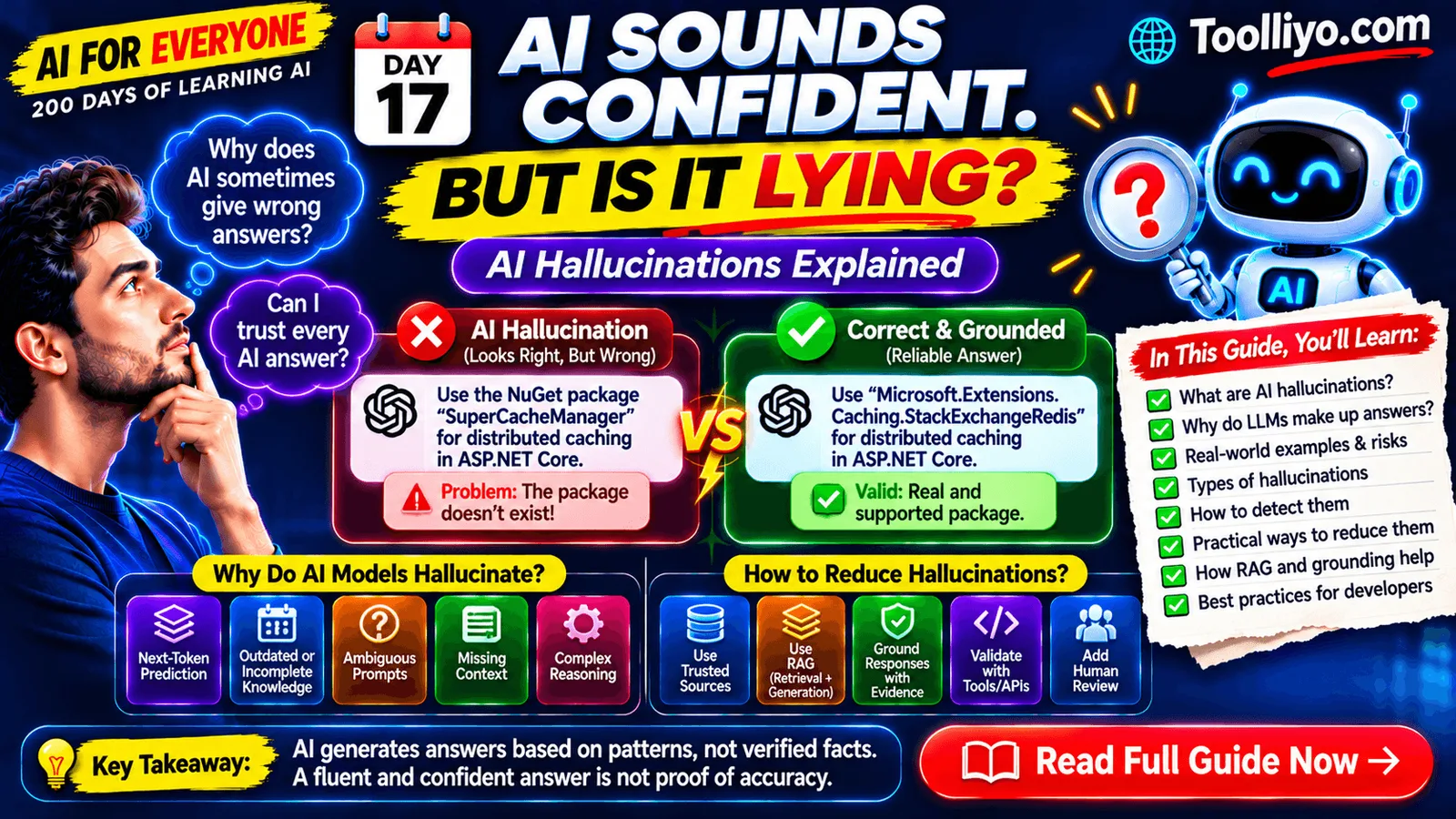
"Which NuGet package should I use to integrate a particular feature into my ASP.NET Core application?"
The AI responds with a detailed explanation. It provides a package name, installation command, code example, and configuration instructions.
Everything looks professional.
You copy the installation command and execute it.
But the package does not exist.
What happened?
The AI generated an answer that looked correct but contained fabricated information.
This behavior is known as an AI Hallucination.
AI hallucinations are one of the most important challenges in Generative AI. They affect chatbots, coding assistants, document question-answering systems, customer support applications, and enterprise AI solutions.
In this guide, we'll understand what hallucinations are, why they happen, how to identify them, and what developers can do to build more reliable AI-powered applications.
1. What Are AI Hallucinations?
An AI hallucination occurs when an AI system generates information that is incorrect, fabricated, unsupported by available evidence, or inconsistent with the source material.
The generated response may sound natural, confident, and professional.
But that does not mean it is true.
Simple example
Ask an AI assistant:
"Who invented the programming language XYZ?"
Suppose XYZ is a fictional programming language.
An unreliable AI response might be:
"XYZ was invented by John Smith in 1998 at ABC Technologies."
The response contains specific details, but those details were fabricated.
A more reliable response would be:
"I cannot verify that XYZ is an established programming language. Could you provide more context?"
The ability to acknowledge uncertainty is important when building trustworthy AI systems.
Another example: Software development
Prompt:
"Show me how to use the fictional SuperCacheManager class in ASP.NET Core."
A hallucinating model might generate:
var cache = new SuperCacheManager();

cache.EnableDistributedMode();
cache.SetExpiration(TimeSpan.FromMinutes(10));
The code may look reasonable, but the class and methods might not exist.
Important: AI hallucination is not necessarily intentional deception. It is a limitation of generative systems. The model can produce plausible language without having verified the underlying facts.
2. Why Do AI Models Hallucinate?
To understand hallucinations, we need to understand how Large Language Models work.
An LLM processes input tokens and generates output tokens based on patterns learned during training and the context it receives.
It does not automatically perform a database lookup or verify every statement against an authoritative source.
Several factors can contribute to hallucinations.
Reason 1: Next-token prediction
Language models are trained to predict and generate sequences of tokens.
They learn statistical and semantic patterns from large datasets.
When generating an answer, the model produces a continuation that fits the learned patterns and current context.
A plausible continuation is not necessarily a factually correct one.
Reason 2: Incomplete or outdated knowledge
A model may not have reliable information about:
-
A newly released software library.
-
Recent product changes.
-
Current government regulations.
-
Newly published research.
-
Updated API specifications.
If the required information is missing or outdated, the model may generate an incorrect answer.
Reason 3: Ambiguous prompts
Consider this prompt:
"Explain the latest .NET features."
Which version?
.NET 8, .NET 9, .NET 10, or a newer release?
Without a specific version and reliable current information, the response may include incorrect assumptions.
Reason 4: Missing context
Suppose you ask:
"Why is my application slow?"
But you provide no:
-
Application architecture.
-
Database details.
-
Logs.
-
Performance metrics.
-
Code.
-
Deployment environment.
The AI may suggest possible causes as if they were confirmed.
A better response should distinguish between hypotheses and verified findings.
Reason 5: Complex reasoning
Some tasks require multiple calculations, dependencies, or logical steps.
For example:
-
Complex financial calculations.
-
Multi-step mathematical problems.
-
Large code transformations.
-
Complicated architectural decisions.
A model may make an error in one step and generate an incorrect final answer.
Reason 6: Conflicting information
Training data or supplied context may contain:
-
Contradictory statements.
-
Incorrect examples.
-
Ambiguous terminology.
-
Unreliable sources.
The model may produce an answer that reflects those inconsistencies.
Reason 7: Pressure to provide an answer
If a model is instructed to answer every question, it may generate a plausible response even when it lacks sufficient evidence.
Good AI application design should allow the system to say:
"I don't have enough reliable information to answer that."
3. Common Types of AI Hallucinations
Let's explore some practical categories.
1. Factual hallucinations
The AI generates incorrect facts.
Example:
"Company ABC was founded in 1980."
But the actual founding year is different.
2. Citation hallucinations
The AI invents:
-
Research paper titles.
-
Author names.
-
Journal references.
-
URLs.
-
Legal citations.
Example:
It provides a research paper title and DOI that cannot be found in the publisher's records.
Always verify references against the original source.
3. Technical hallucinations
The AI generates:
-
Non-existent methods.
-
Incorrect API names.
-
Invalid package references.
-
Unsupported configuration options.
-
Incorrect code examples.
This is particularly important for software developers.
4. Contextual hallucinations
The AI ignores or misinterprets information supplied in the conversation or documents.
Example:
A company refund policy says refunds are available within seven days.
The AI tells the customer that refunds are available within thirty days.
5. Mathematical hallucinations
The AI provides incorrect calculations or numerical results.
Important calculations should be checked using deterministic code, calculators, or trusted tools.
6. Source-grounding errors
The AI receives documents but produces statements that are not supported by those documents.
This can happen in document question-answering applications, including RAG systems.
Remember: RAG can reduce unsupported answers, but it does not eliminate hallucinations.
4. Why Are AI Hallucinations Dangerous?
The impact depends on where and how the AI system is used.
In software development
-
Incorrect code.
-
Non-existent packages.
-
Unsupported API methods.
-
Insecure implementation suggestions.
-
Incorrect architecture recommendations.
In customer support
-
Incorrect refund information.
-
Wrong product details.
-
False delivery commitments.
-
Incorrect policy explanations.
In healthcare
-
Incorrect medical explanations.
-
Misleading treatment information.
-
Unsupported health claims.
AI-generated medical information requires appropriate professional verification.
In finance
-
Incorrect calculations.
-
Fabricated market information.
-
Unsupported investment claims.
In legal applications
-
Invented legal cases.
-
Incorrect regulations.
-
False citations.
These examples show why high-impact AI applications need strong validation and human oversight.
5. How Can We Reduce AI Hallucinations?
There is no single technique that guarantees hallucination-free AI.
However, we can combine several methods to improve reliability.
Technique 1: Write Clear Prompts
Give the model clear instructions.
Weak prompt:
Explain the refund policy.Better prompt:
Answer the customer's question using only
the refund policy provided below.

If the answer is not available in the policy,
say that you cannot find the information.

Do not invent refund rules.
Clear instructions can reduce ambiguity, although they cannot guarantee factual accuracy.
Technique 2: Use Trusted Sources
Provide reliable information instead of expecting the model to answer entirely from its learned knowledge.
Examples:
-
Official product documentation.
-
Internal company knowledge bases.
-
Verified databases.
-
Approved policy documents.
-
Trusted APIs.
The model should be grounded in information relevant to the task.
Technique 3: Use RAG
Retrieval-Augmented Generation is an important approach for reducing unsupported answers.
We covered RAG in Day 14.
RAG allows an application to retrieve relevant information from an external knowledge source and provide it to an LLM as context.
Simplified workflow:
-
User asks a question.
-
Application converts the question into an embedding.
-
Vector search retrieves relevant document chunks.
-
Retrieved content is added to the prompt.
-
The LLM generates an answer using the supplied context.
-
The application presents the answer and, where supported, source references.
Example:
A company has 500 pages of internal documentation.
Instead of expecting the LLM to know every company policy, the application retrieves relevant documents before generating the response.
RAG improves access to current and domain-specific information, but retrieved documents may still be incomplete, irrelevant, or incorrect. The model can also misinterpret them.
Technique 4: Ground Responses With Evidence
Ask the AI to support factual claims using supplied sources.
Example:
Answer the question using the supplied documents.

For every important factual claim:
- Identify the supporting document.
- Include a relevant source reference.
- Do not introduce unsupported information.
- If evidence is insufficient, say so.
For production systems, citations should be generated from actual retrieved source metadata and validated by the application.
Do not trust a citation simply because the model generated one.
Technique 5: Use Structured Outputs
Ask the model to return a predictable structure.
Example:
{
  "answer": "string",
  "confidence": "low | medium | high",
  "sources": [],
  "needsHumanReview": true
}
Structured outputs make it easier to validate and process responses.
Important: a model-generated confidence value is not a calibrated probability of correctness. It must not be treated as proof that the answer is true.
Technique 6: Validate With External Tools
Use deterministic tools for tasks that require exact results.
Examples:
| Task | Better validation method |
|---|---|
| Mathematical calculation | Calculator or code |
| Package availability | NuGet package registry |
| Current weather | Weather API |
| Product inventory | Database or inventory API |
| Current regulations | Official government sources |
| Database records | Authorized database query |
| Code compilation | Build and test pipeline |
Instead of asking an LLM to guess, let it call a suitable tool when the application supports tool integration.
Technique 7: Add Human Review
For sensitive or high-impact use cases, human review is essential.
Examples:
-
Medical recommendations.
-
Financial decisions.
-
Legal document preparation.
-
Security-sensitive code.
-
Customer refunds and exceptions.
AI can assist with analysis, but a qualified person should verify important decisions.
6. How RAG Helps Reduce Hallucinations
Let's understand a practical business example.
Imagine building an AI assistant for an e-commerce company.
The company has documents containing:
-
Refund policies.
-
Delivery information.
-
Product details.
-
Warranty conditions.
-
Customer support guidelines.
A customer asks:
"Can I return a product after 15 days?"
Without RAG
The model generates an answer from its learned knowledge and the conversation context.
It may invent a return policy.
With RAG
The application:
-
Searches the approved refund policy.
-
Retrieves the relevant section.
-
Passes that section to the LLM.
-
Instructs the LLM to answer using the retrieved content.
-
Returns the response with a reference to the actual policy.
The result is more grounded in company information.
However, if the wrong document is retrieved or the policy is outdated, the answer can still be wrong.
Key lesson: Better retrieval and better grounding improve reliability, but neither guarantees correctness.
7. Developer Guide: Building More Reliable AI Applications
Now let's translate these concepts into application architecture.
Suppose you are building an AI-powered customer support application using ASP.NET Core or Node.js.
A production-oriented flow could look like this:
User Question
     |
     v
API Authentication
     |
     v
Input Validation
     |
     v
Retrieve Authorized Context
     |
     v
Build Structured Prompt
     |
     v
Call LLM
     |
     v
Validate Generated Response
     |
     v
Verify Source References
     |
     v
Human Review (when required)
     |
     v
Return Response
Important implementation considerations
1. Input validation
Validate incoming requests, enforce size limits, and reject malformed input.
2. Authorization
Retrieve only the information the authenticated user is allowed to access.
3. Context management
Pass relevant and current information rather than blindly including every available document.
4. Prompt construction
Separate trusted application instructions from untrusted user input and retrieved document content.
5. Output validation
Validate response schemas, required fields, and business rules.
6. Source validation
Check that cited sources actually exist and support the relevant statements.
7. Monitoring
Record useful operational metadata, retrieval quality, latency, failures, and user feedback. Protect sensitive information in logs.
8. Evaluation
Test the application against a representative set of questions with known expected answers.
8. Example: A Safer ASP.NET Core AI Response Contract
A response contract can make it easier for an application to distinguish supported answers from insufficient evidence.
Example using C#:
public class AiAnswerResponse
{
    public string Answer { get; set; } = string.Empty;

    public bool HasSupportingEvidence { get; set; }

    public bool NeedsHumanReview { get; set; }

    public List<SourceReference> Sources { get; set; } = [];
}

public class SourceReference
{
    public string DocumentId { get; set; } = string.Empty;

    public string DocumentName { get; set; } = string.Empty;

    public string? Section { get; set; }
}
This is an application-level contract, not a hallucination detector.
Your backend must still verify:
-
The document exists.
-
The user has permission to access it.
-
The cited section supports the answer.
-
Required response fields are valid.
-
High-risk answers are routed for review.
A model returning HasSupportingEvidence = true does not prove that evidence exists. That value must be checked by trusted application logic.
9. How to Evaluate AI Hallucinations
You cannot improve reliability without testing it.
Create a test dataset containing:
-
Questions with known answers.
-
Questions whose answers are missing from the knowledge base.
-
Questions with ambiguous wording.
-
Questions involving conflicting documents.
-
Questions requiring current information.
-
Questions containing misleading instructions.
Measure several dimensions:
1. Factual accuracy
Are the generated claims correct?
2. Groundedness
Are claims supported by the supplied sources?
3. Retrieval relevance
Did the system retrieve the correct information?
4. Citation correctness
Do the cited sources exist and support the claims?
5. Abstention quality
Does the system refuse to guess when sufficient evidence is unavailable?
6. Safety and privacy
Does the application avoid exposing unauthorized information?
A useful evaluation approach combines automated metrics, test cases, source verification, and human review.
10. Common Myths About AI Hallucinations
Myth 1: Better prompts eliminate hallucinations.
Reality: Better prompts can reduce ambiguity, but they cannot guarantee factual accuracy.
Myth 2: RAG completely prevents hallucinations.
Reality: RAG improves grounding, but retrieval and generation can still fail.
Myth 3: A confident AI answer is a correct answer.
Reality: Fluency and confidence are not evidence.
Myth 4: Fine-tuning removes hallucinations.
Reality: Fine-tuning can improve behavior for specific tasks, but it does not guarantee factual correctness.
Myth 5: More data always means fewer hallucinations.
Reality: Data quality, relevance, coverage, and evaluation matter more than simply increasing the quantity of data.
11. Your Practical Challenge: Test AI Hallucinations
Try this exercise using an AI assistant.
Ask these five questions:
-
Explain a technical concept you already understand.
-
Give an example using a real software library.
-
Provide references for a technical claim.
-
Answer a question using a document you provide.
-
Ask a question whose answer is deliberately missing from that document.
For each response, check:
-
Are the facts correct?
-
Do the libraries and APIs actually exist?
-
Are the references genuine?
-
Does the answer match the supplied document?
-
Does the AI admit when it does not know?
Record the results.
This exercise will help you understand why AI outputs need verification.
12. Frequently Asked Questions
Q1. What is an AI hallucination?
An AI hallucination occurs when an AI system generates incorrect, fabricated, or unsupported information that may sound convincing.
Q2. Why do ChatGPT and other LLMs hallucinate?
LLMs generate responses based on learned patterns and available context. They do not automatically verify every generated statement against authoritative sources.
Q3. Can prompt engineering prevent hallucinations?
Prompt engineering can reduce ambiguity and instruct models to acknowledge missing information. It cannot eliminate hallucinations.
Q4. Does RAG eliminate AI hallucinations?
No. RAG can improve factual grounding by retrieving relevant information, but incorrect retrieval, incomplete documents, and generation errors can still occur.
Q5. What is grounding in Generative AI?
Grounding means connecting an AI-generated response to relevant, trusted information such as documents, databases, or verified external sources.
Q6. Can AI hallucinate while generating code?
Yes. AI can generate non-existent methods, incorrect package names, invalid APIs, and code that does not compile.
Q7. How can developers build reliable AI applications?
Combine trusted data, RAG, authorization, structured outputs, deterministic validation, monitoring, evaluation, and human review where appropriate.
Conclusion: Never Confuse a Convincing Answer With a Correct Answer
AI hallucinations remind us that Generative AI is powerful, but it is not automatically reliable.
An answer can be:
-
Well written.
-
Technically detailed.
-
Confidently presented.
-
Completely incorrect.
As AI developers and users, we must learn to verify what AI generates.
Remember these principles:
-
Never assume that a confident response is correct.
-
Use trusted and current information.
-
Ground responses in relevant sources.
-
Validate generated outputs.
-
Test AI applications systematically.
-
Use human review for high-impact decisions.
The future of AI is not just about generating intelligent answers. It's about building systems that produce useful, verifiable, and trustworthy results.
Continue Learning — AI for Everyone
This is Day 17 of 200 Days of Learning AI.
Explore more practical technology resources at Toolliyo.com.
For personalized developer mentorship, interview preparation, and career guidance, visit Topmate.
Tomorrow — Day 18: What Is AI Model Temperature? How AI Controls Creativity and Randomness.
Learn one AI concept every day. Build your understanding step by step.