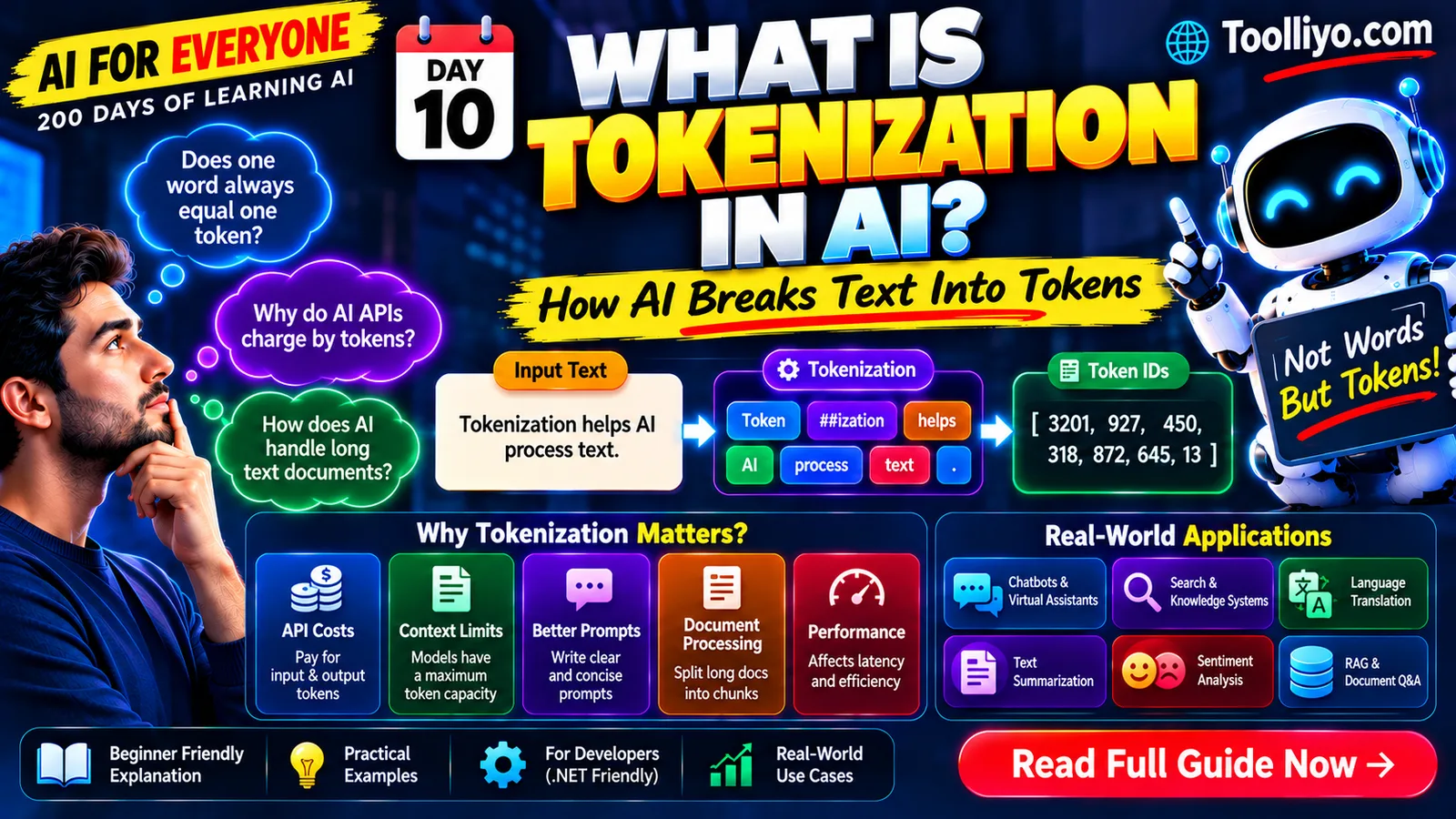
AI for Everyone — Day 10 of 200
You type a short question into an AI tool. The model processes your request, generates an answer, and reports usage in tokens.
But what exactly is a token?
Is it a word? A character? A sentence? And why do tokens matter when you're building AI applications?
Understanding tokenization is essential for anyone working with Large Language Models (LLMs), Generative AI, prompt engineering, or AI APIs.
Tokenization is one of the steps that allows language models to represent text as data they can process. It also affects context limits, API usage, document processing, and application design.
In this guide, you'll learn what tokens are, how tokenization works, why different models can count the same text differently, and how developers can use this knowledge in real-world AI applications.
1. What Is Tokenization?
Tokenization is the process of dividing text into smaller units called tokens.
Depending on the tokenizer, a token may represent:
-
A complete word
-
Part of a word
-
Punctuation
-
Whitespace combined with text
-
Another unit defined by the tokenizer
For example, consider this sentence:
AI is changing software development.
A tokenizer might represent parts of the sentence as separate tokens. However, the exact token boundaries depend on the tokenizer used by the model.
A token is not necessarily the same as a word or a character.
This distinction matters because many modern language models process text through token IDs—numerical identifiers corresponding to entries in a tokenizer's vocabulary.
The model operates on these numerical representations rather than directly processing ordinary text as humans see it.
2. Why Do AI Models Use Tokens?
Computers can store text as characters, but modern language models commonly operate on token sequences.
Tokenization provides a practical way to represent text using a vocabulary of reusable units.
Imagine a model that had to assign a completely separate vocabulary entry to every possible word, name, spelling variation, and new term. The vocabulary would become difficult to manage.
Many modern tokenizers instead use subword or related methods that can represent common words efficiently while also handling less common words through smaller units.
For example, an unfamiliar technical term might be represented by several tokens rather than requiring one dedicated token for the entire term.
This approach helps language models process varied text, including new names, technical vocabulary, and different word forms.
The exact method depends on the tokenizer and model family.
3. What Is the Difference Between a Token, Word, and Character?
These three concepts are related but different.
| Unit | Meaning | Example |
|---|---|---|
| Character | An individual text character or symbol, depending on the representation | A, 7, ? |
| Word | A linguistic unit separated by spaces or other language-specific boundaries | Artificial Intelligence contains two words |
| Token | A unit produced by a tokenizer | May represent a word, part of a word, punctuation, or another text unit |
Consider this sentence:
Tokenization helps AI.
It contains three words when split by spaces and punctuation in a simple word-counting approach.
But the number of tokens is determined by the tokenizer. It might not equal three.
Likewise, a single long technical word may be split into several tokens, while common words may each be represented by one token.
The key lesson: never assume that the number of words equals the number of tokens.
4. How Does Tokenization Work?
Let's follow a simplified workflow.
Step 1: Receive the text
An application sends text to a model.
Example:
Explain machine learning to a beginner.
Step 2: Apply the tokenizer
The tokenizer divides the text into units according to its vocabulary and rules.
It may preserve some spaces or punctuation as part of token representations. Token boundaries are not necessarily aligned with word boundaries.
Step 3: Convert tokens into token IDs
Each token corresponds to an identifier in the tokenizer's vocabulary.
For illustration only, a tokenizer could produce a sequence like:
[token_id_1, token_id_2, token_id_3, ...]
These placeholders are not actual IDs for the sentence. Real IDs depend on the specific tokenizer.
Step 4: Process the token sequence
The model uses the token IDs as part of its input representation. Depending on the architecture, these IDs are mapped to numerical vectors called embeddings and processed by the neural network.
Step 5: Generate output tokens
For a generative language model, the model predicts tokens sequentially or through another architecture-specific generation process.
Step 6: Convert output tokens back into text
The generated token sequence is decoded into readable text.
The final response may contain more tokens than the original input because the model generates additional content.
This simplified workflow explains why tokenization is an important part of many modern language-model systems.
5. What Is a Tokenizer Vocabulary?
A tokenizer vocabulary is a collection of token units that the tokenizer can represent.
Many modern language models use subword tokenization approaches, including methods related to Byte Pair Encoding (BPE) or other vocabulary-construction techniques.
A vocabulary may include common words, word fragments, punctuation, and other units.
The goal is to represent language efficiently while still being able to process text that contains uncommon or unfamiliar words.
Why vocabulary design matters
Suppose a model frequently encounters the word development.
A tokenizer might represent it as one token or as multiple smaller tokens, depending on its vocabulary.
An uncommon technical term may be split into smaller pieces.
This can affect:
-
How many tokens a prompt uses
-
How much text fits into a context window
-
API usage and cost
-
Processing efficiency
-
How text is represented internally
There is no universal token vocabulary shared by every AI model. Different models may use different tokenizers.
6. Why Does Token Count Matter in Generative AI?
Token count matters for several practical reasons.
A. API costs
Many hosted model APIs price usage based on input and output tokens, although pricing structures differ between providers and models.
Input tokens may include the prompt, instructions, conversation history, and supplied context. Output tokens include the generated response.
Some systems have separate pricing for cached input, reasoning tokens, or other categories.
Before estimating costs, check the pricing rules for the exact model and service you use.
Practical tip: Measure token usage from real requests rather than estimating cost using word counts alone.
B. Context window limits
A model's context window determines how much input and output it can handle within a request or processing context, subject to the model's specific rules.
A request may contain:
-
System instructions
-
User messages
-
Conversation history
-
Retrieved documents
-
Tool results
-
The requested response
All of this can contribute to context usage, depending on the system.
If the context is too large, the application may need to shorten the conversation, retrieve fewer documents, summarize earlier content, or divide the work into multiple requests.
C. Response length
Generated text also consumes tokens.
A long response generally uses more output tokens than a short response, although the relationship between visible text length and token count varies.
Where supported, output limits can help control response length and cost.
D. Latency and throughput
Processing more tokens can increase latency and resource usage, particularly for long prompts or generated responses.
Actual performance depends on the model, hardware, serving infrastructure, batching, and other factors.
For high-volume applications, token efficiency can be an important part of performance optimization.
7. Does One Word Always Equal One Token?
No.
This is one of the most common misunderstandings about tokenization.
A short, common word may be represented by one token. A longer or less common word may be split into multiple tokens.
Punctuation and whitespace can also affect token boundaries.
Different tokenizers may represent the same text differently.
For this reason, rules such as "one word equals one token" or "every four characters equal one token" should not be treated as exact calculations.
Rough token estimates can be useful for initial planning, but actual token counts should be measured using the tokenizer or counting tool appropriate to the model.
This becomes especially important when you work with:
-
Technical documentation
-
Code
-
Multilingual text
-
Long conversations
-
Structured data
-
Documents with unusual formatting
8. What Is the Difference Between Tokenization and Embeddings?
Tokenization and embeddings are connected, but they perform different roles.
Tokenization converts text into token units that can be mapped to token IDs.
Embeddings are numerical vector representations used to represent tokens or other information in a mathematical space.
A simplified language-model pipeline looks like this:
Text → Tokens → Token IDs → Embeddings → Neural network processing
Embeddings help the model work with numerical representations that can capture useful relationships learned during training.
For example, a model may learn useful statistical relationships between words or word fragments that appear in similar contexts.
However, tokenization alone does not give a system an understanding of language. It is one component of a broader model architecture and training process.
We'll explore embeddings in a future lesson in this AI learning series.
9. What Is Tokenization in Large Language Models?
Large Language Models process token sequences as part of their input and output workflows.
When you submit a prompt to an LLM, the system generally converts the text into tokens before processing it.
The model uses those representations to calculate its output.
For example, when you ask:
Explain APIs to a beginner.
the tokenizer converts the text into a sequence of token IDs. The model then processes that sequence and generates a response represented as output tokens.
The generated tokens are decoded into readable text.
This process is central to many transformer-based language models, although model architectures and service implementations can differ.
Why LLM developers should care
Understanding tokenization helps developers:
-
Estimate API usage
-
Manage context windows
-
Control prompt length
-
Design document-processing workflows
-
Avoid unexpectedly oversized requests
-
Optimize retrieval-augmented generation applications
Tokenization is not the only factor that determines cost or performance, but it is one developers can measure and manage.
10. What Is Tokenization in Retrieval-Augmented Generation (RAG)?
Retrieval-Augmented Generation (RAG) combines information retrieval with a generative model to help answer questions using supplied documents or other sources.
Tokenization matters in RAG because both the retrieved context and the model's answer consume tokens.
Consider an internal company knowledge assistant.
An employee asks:
What is our refund policy for damaged products?
The application may retrieve relevant sections from company documents and send those sections to a language model along with the question and instructions.
If too much irrelevant context is included, the request can become expensive, slow, or difficult for the model to handle effectively.
Where tokenization fits into RAG
-
Documents are collected and processed.
-
Documents are split into chunks.
-
Relevant chunks are retrieved for a question.
-
The application assembles a prompt containing the question and retrieved context.
-
The model processes the request and generates an answer.
-
The application validates or presents the result.
Token counts can help manage the size of retrieved context.
However, tokenization and chunking are not the same thing.
Tokenization divides text into tokenizer-defined units. Chunking divides documents into larger sections for processing or retrieval.
A RAG application may use token counts to guide chunk sizes, but chunking also depends on document structure, meaning, retrieval quality, and the model's requirements.
11. Practical Ways to Reduce Unnecessary Token Usage
If you are building AI applications, you can often improve efficiency without sacrificing important information.
1. Keep prompts focused
Avoid repeating instructions or adding irrelevant background information.
A concise prompt can reduce input usage while preserving the information needed for the task.
2. Limit unnecessary conversation history
Long chat histories can consume significant context.
Where appropriate, retain relevant messages, summarize older context, or use a suitable conversation-state strategy.
Be careful not to remove information required to answer correctly.
3. Retrieve relevant documents
For RAG applications, retrieve a small set of relevant document chunks rather than sending an entire knowledge base with every request.
Measure retrieval quality as well as token usage. Too little context can make answers incomplete.
4. Set output limits
Use supported output-token limits when you need a concise answer.
Choose a limit that is suitable for the task. An overly restrictive limit can truncate useful output.
5. Choose the right model
Different models have different capabilities, tokenizers, prices, and context limits.
A smaller or less expensive model may be suitable for simple classification or extraction, while more complex tasks may require a more capable model.
Evaluate quality before changing models in production.
6. Measure actual usage
Inspect usage information returned by the API, where available.
Track input tokens, output tokens, latency, errors, and costs over time.
Real measurements are more useful than relying entirely on rough estimates.
12. How Can Developers Count Tokens?
The correct approach depends on the model and provider.
Use the provider's tokenizer
Some providers offer tokenizer tools or libraries that let you inspect how a particular model represents text.
Use a compatible tokenizer whenever exact or close token counts are important.
Inspect API usage metadata
Many model APIs return usage information with a response. Depending on the provider, this may include input tokens, output tokens, or additional token categories.
Use that information to understand actual usage in your application.
Test representative examples
Tokenization can vary with language, formatting, code, punctuation, and the selected model.
Test real examples from your workload instead of relying only on short English sentences.
Important implementation note
Do not assume a token-counting library for one model produces accurate counts for another model. Verify tokenizer compatibility and check the provider's documentation for model-specific behavior.
13. Tokenization for .NET Developers
If you build AI applications with C# and ASP.NET Core, tokenization can help you manage request size and application cost.
You do not necessarily need to implement a tokenizer yourself. Depending on the model provider, you may be able to use an official tokenizer library, a supported SDK, or API usage metadata.
A practical implementation strategy is:
-
Select the model and provider.
-
Identify the compatible tokenizer or token-counting method.
-
Measure token usage for typical prompts and documents.
-
Enforce suitable request and response limits.
-
Log usage metrics without unnecessarily recording sensitive content.
-
Review cost and latency under realistic workloads.
Example project: Token usage monitor
Build a small ASP.NET Core service that records token usage for calls to an AI API.
The application could track:
-
Model name
-
Input token count
-
Output token count
-
Request duration
-
Success or failure
-
Estimated cost based on the applicable pricing configuration
Avoid hardcoding prices permanently because model pricing can change. Keep pricing configurable and calculate estimates using the correct rate structure for the model and usage category.
This project can help you understand how prompt design and output length affect application costs.
14. Common Tokenization Mistakes
Mistake 1: Assuming every word is one token.
Reality: Token boundaries depend on the tokenizer.
Mistake 2: Assuming all models use the same tokenizer.
Reality: Tokenizers and vocabularies can differ between model families.
Mistake 3: Thinking tokenization is the same as understanding.
Reality: Tokenization represents text in a form the model can process. Language modeling involves additional architecture and learned parameters.
Mistake 4: Ignoring output tokens.
Reality: Generated responses can contribute significantly to usage and cost.
Mistake 5: Sending every document to the model.
Reality: Irrelevant context can waste tokens and reduce the efficiency of retrieval-based workflows.
Mistake 6: Treating token estimates as exact.
Reality: Use model-compatible tools or API usage data for reliable measurements.
15. Frequently Asked Questions
What is a token in AI?
A token is a unit produced by a tokenizer. It may represent a word, part of a word, punctuation, or another unit defined by the tokenizer.
How many tokens are in one word?
There is no fixed number. Some words may use one token, while others may use several. The count depends on the tokenizer and the text.
Why do AI APIs charge by tokens?
Many model providers use input and output token counts as part of their pricing. The exact billing structure varies by model and service.
Are tokens the same as characters?
No. Characters are individual text symbols, while tokens are units defined by a tokenizer. A token can represent multiple characters or part of a word.
Do all LLMs use the same tokenizer?
No. Different models can use different vocabularies and tokenization methods. Use tools compatible with your chosen model.
What is the relationship between tokens and embeddings?
Tokens are units of text produced by a tokenizer. Token IDs are commonly mapped to embedding vectors that the model uses for further processing.
Does tokenization affect RAG?
Yes. Retrieved document context and generated answers consume tokens. Token counts can help developers manage context limits and costs, while document chunking and retrieval determine which information is supplied.
Can .NET developers count tokens?
Yes. Depending on the provider and model, developers can use compatible tokenizer libraries, supported SDKs, or usage metadata returned by an API.
Conclusion: Understand Tokens Before Building at Scale
Tokenization may seem like a small technical detail, but it influences how modern language models process text.
Remember these key points:
-
Tokenization divides text into tokenizer-defined units.
-
Tokens are not the same as words or characters.
-
Token counts can affect API usage, context limits, latency, and application design.
-
Different models may use different tokenizers.
-
RAG applications can use token counts to manage retrieved context.
-
Developers should measure actual usage rather than relying entirely on estimates.
You do not need to become a tokenizer expert to build AI applications. But understanding the basics will help you design more efficient, cost-aware, and reliable systems.
Learn the fundamentals. Measure what matters. Build smarter AI applications.
Continue learning with Toolliyo
Explore practical AI and developer guides at https://toolliyo.com.
For mentorship and career guidance, visit https://topmate.io/sandeeppal.
Coming next — Day 11: What Are Large Language Models (LLMs), and How Do They Work?
AI for Everyone — 200 Days of Learning AI, One Concept at a Time.