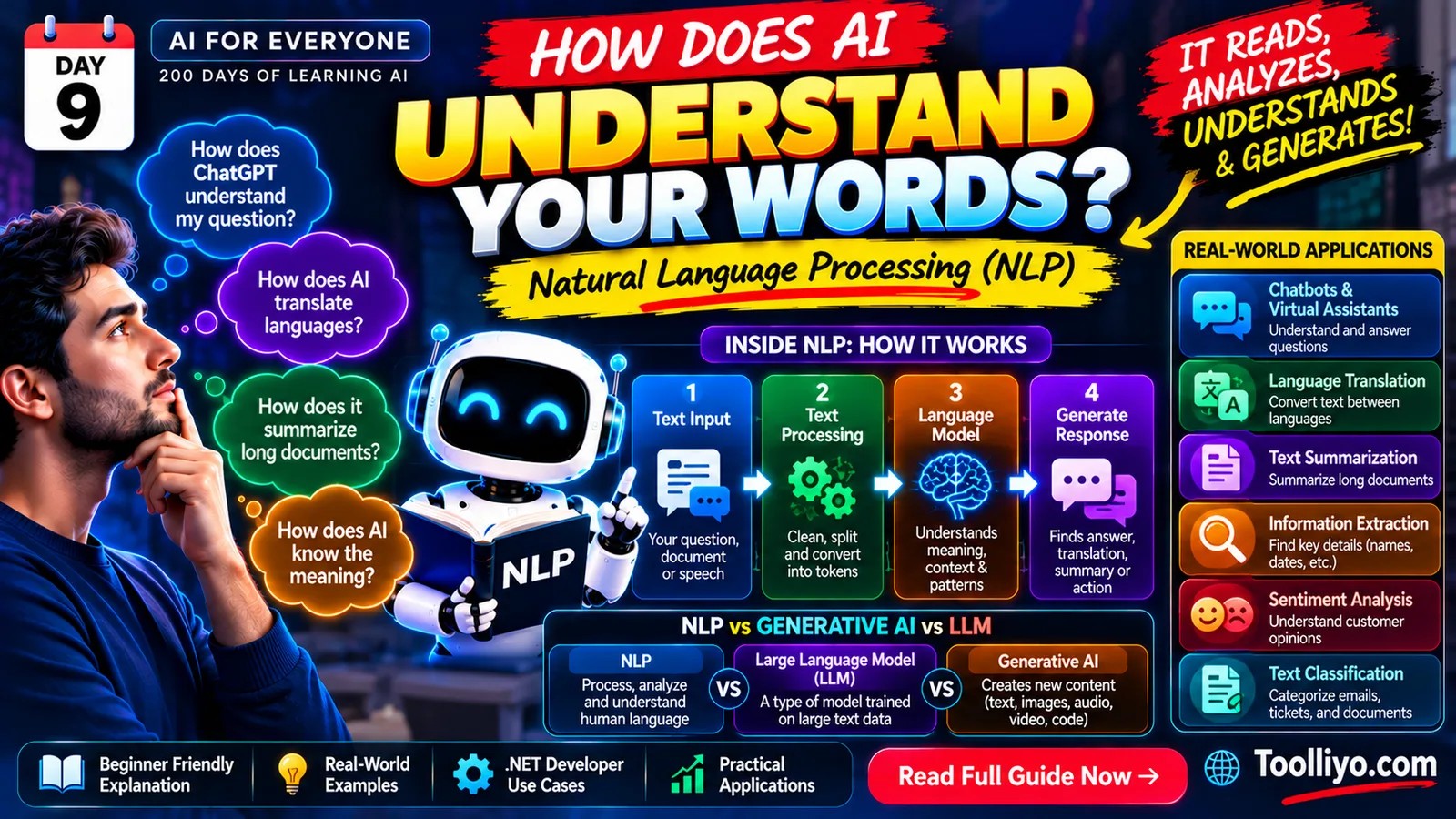
AI for Everyone — Day 9 of 200
You ask an AI assistant a question. It responds in natural language.
You translate a message from Hindi to English. A translation system produces another sentence.
You submit hundreds of customer reviews. An AI system identifies common complaints and positive feedback.
How can computers perform these tasks using human language?
One important field behind these capabilities is Natural Language Processing (NLP).
NLP is a field of Artificial Intelligence focused on enabling computers to process, analyze, interpret, and generate human language. It combines ideas from computer science, linguistics, statistics, and machine learning.
In this beginner-friendly guide, you'll learn what NLP is, how it works, which techniques it uses, how it differs from Generative AI and Large Language Models, and how developers can use it to build practical applications.
1. What Is Natural Language Processing?
Natural Language Processing, commonly called NLP, is a field of AI concerned with working with human language in text or speech-related applications.
Human languages are complicated. Words can have multiple meanings, sentences can be ambiguous, and the same message can communicate different things depending on context.
Consider this sentence:
"I saw her duck."
What does it mean?
-
You saw a woman lower her head.
-
You saw a duck belonging to her.
The words are identical, but the meaning changes with context.
NLP techniques help computer systems process language and address challenges such as ambiguity, grammar, meaning, and context. How well a system handles these challenges depends on its method, model, data, and task.
NLP powers many familiar technologies, including:
-
Chatbots and conversational assistants
-
Search engines
-
Language translation
-
Email spam filtering
-
Sentiment analysis
-
Speech transcription
-
Document classification
-
Information extraction
-
Text summarization
-
Language generation
NLP does not automatically mean that a computer understands language in the same way a human does. Systems learn or apply computational representations and methods to perform particular language tasks.
2. Why Is NLP Important?
Text and speech contain enormous amounts of useful information.
Businesses receive emails, customer reviews, support tickets, contracts, reports, chat messages, and feedback every day. Manually processing all this information can be slow and expensive.
NLP helps automate parts of this work.
Example: Customer feedback analysis
Imagine an e-commerce company receives 20,000 customer reviews in one month.
The company wants to answer several questions:
-
Are customers satisfied with the products?
-
Which complaints appear most frequently?
-
Are delivery delays becoming a problem?
-
Which product features receive positive feedback?
-
Which reviews require human attention?
An NLP system can classify reviews, extract relevant topics, identify sentiment signals, and summarize recurring patterns.
Employees can then investigate the results and make better-informed decisions.
The system may still misinterpret sarcasm, unusual wording, or mixed opinions. Human review and quality checks remain important, especially when decisions affect customers.
The business value of NLP is not merely processing words. It is turning language into useful information.
3. How Does NLP Work?
There is no single workflow that applies to every NLP system. A simple text-classification application follows a different process from a modern conversational AI model.
However, a typical NLP workflow includes the following stages.
Step 1: Receive the language input
The application receives text from a user, document, email, review, or another source.
For a speech application, a speech recognition component may first convert audio into text. Some systems process audio directly without requiring a separate transcription stage.
Example input:
"The delivery was late, and the packaging was damaged."
Step 2: Prepare and represent the text
Depending on the approach, the application may normalize text, split it into units, handle punctuation, or convert it into numerical representations.
Traditional NLP pipelines often use explicit preprocessing steps. Modern neural models may use tokenization and learned representations without requiring every traditional preprocessing operation.
Step 3: Process the language
The system applies a suitable method or model.
Examples include:
-
A classifier that categorizes a support ticket.
-
A sentiment model that estimates the expressed sentiment.
-
A named entity recognition model that extracts names and dates.
-
A language model that generates a response.
Step 4: Produce an output
The output depends on the task.
For the delivery complaint, the system might return:
-
Category: Delivery issue
-
Sentiment: Negative
-
Key phrase: Packaging was damaged
These are example outputs, not guaranteed conclusions. A real system needs evaluation to determine how reliably it performs the task.
Step 5: Evaluate and improve
Check the system's performance against representative examples.
For classification tasks, you might measure precision, recall, and F1 score. For generation tasks, evaluation may involve factual accuracy, relevance, completeness, safety, and human review.
Step 6: Integrate and monitor
Connect the NLP capability to the application or business workflow.
Monitor performance, response time, cost, and failure cases. Language changes over time, so a model may require reevaluation as users, topics, and business needs evolve.
4. Important NLP Techniques You Should Know
NLP includes many techniques. The right one depends on what you want the application to do.
A. Text classification
Text classification assigns a category to a piece of text.
Examples:
-
Spam or legitimate email
-
Billing or technical support ticket
-
Complaint or compliment
-
Urgent or non-urgent request
A support application might automatically route billing questions to the finance support team.
B. Sentiment analysis
Sentiment analysis estimates the sentiment expressed in text.
A product review such as "The battery lasts all day, and the screen looks excellent" may be classified as positive.
A review such as "The device overheats after ten minutes" may be classified as negative.
Real-world sentiment can be mixed or ambiguous. Sarcasm, context, language variation, and domain-specific expressions can make accurate analysis difficult.
C. Named Entity Recognition (NER)
Named Entity Recognition identifies entities such as people, organizations, locations, dates, and other defined categories in text.
Example:
"Microsoft announced a product update in Seattle on Monday."
A suitable NER model might identify:
-
Microsoft: Organization
-
Seattle: Location
-
Monday: Date or time expression
The exact categories and output depend on the model and task.
D. Machine translation
Machine translation converts text from one language into another.
For example:
"Good morning. How are you?"
could be translated into another language while attempting to preserve the meaning and tone.
Translation quality varies with language pair, domain, context, and the system being used. Important or sensitive translations may require human review.
E. Text summarization
Text summarization produces a shorter representation of a longer document.
There are two broad approaches:
-
Extractive summarization: Selects important portions of the original text.
-
Abstractive summarization: Generates new wording intended to capture the main points.
Summarization can help with reports, meeting notes, research documents, and customer feedback. Generated summaries must still be checked for omissions and unsupported claims.
F. Information extraction
Information extraction identifies specific information from unstructured text.
For example, an invoice-processing workflow may extract:
-
Invoice number
-
Invoice date
-
Supplier name
-
Total amount
-
Payment due date
Extraction systems should validate important fields against business rules and source documents instead of assuming every extracted value is correct.
G. Question answering
Question-answering systems produce answers to questions using model knowledge, supplied context, or retrieved documents.
For example, an employee might ask:
"What is our leave policy?"
An internal assistant could retrieve the relevant company policy and use it to formulate a response.
For business use, retrieval and source citations can help users verify answers. They do not eliminate the need to test for incorrect or incomplete responses.
5. What Is Tokenization, and Why Does NLP Need It?
Computers process numerical representations, so language models need a way to represent text as data.
Tokenization divides text into units called tokens according to a tokenizer's rules.
A token may represent a word, part of a word, punctuation, or another unit. Tokens do not always correspond to complete words.
For example, the sentence:
"AI is changing software development."
might be split into tokens representing parts of the sentence. The exact tokens depend on the tokenizer.
Tokenization is important because many modern language models process token sequences rather than raw text characters directly.
Tokenization can affect:
-
How text is represented.
-
How long an input becomes.
-
How much context a model can process.
-
The cost of using certain hosted model APIs.
Different models may use different tokenization schemes. Token counts should not be assumed to equal word counts.
We'll explore this topic in detail in Day 10 of the AI for Everyone series.
6. What Is the Difference Between NLP, Machine Learning, and Deep Learning?
These concepts are related but describe different things.
| Concept | Meaning | Example |
|---|---|---|
| Artificial Intelligence | The broader field of creating systems that perform tasks associated with intelligence | An intelligent document-processing system |
| Machine Learning | Methods that learn patterns from data | A model that classifies support tickets |
| Deep Learning | Machine Learning using neural networks with multiple layers | A neural model that processes language |
| NLP | A field focused on computational processing of human language | Translation or sentiment analysis |
NLP is a problem domain and research field, while Machine Learning and Deep Learning provide approaches that can be used to solve NLP tasks.
NLP systems do not always require machine learning. Some use rules, dictionaries, grammar-based methods, or combinations of approaches.
Modern NLP, however, relies heavily on machine learning and Deep Learning for many challenging tasks.
7. What Is the Difference Between NLP and Generative AI?
This is an important distinction.
NLP focuses on processing and working with human language. Its tasks include classification, extraction, translation, summarization, and generation.
Generative AI refers to AI systems that generate new content, such as text, images, audio, video, or code.
Modern text-generating AI systems often use NLP techniques and Deep Learning. But Generative AI is broader than NLP because it can also generate non-text content.
For example:
-
An email spam classifier is an NLP application, but it does not need to generate text.
-
A sentiment analysis model is an NLP application, but it may only output a label or score.
-
A chatbot that generates answers is both a language-processing application and a generative AI application.
-
An image generation model is Generative AI, but it is not primarily an NLP system.
Understanding this distinction helps you choose the right technology for a particular application.
8. What Is the Difference Between NLP and Large Language Models?
A Large Language Model (LLM) is a type of model trained to process and generate language at scale.
LLMs are used in many modern NLP applications, including question answering, summarization, translation, information extraction, and conversational assistants.
But NLP is not the same as an LLM.
NLP is the broader field. An LLM is one type of model that can be used for many NLP tasks.
Consider three ways to classify customer reviews:
-
A rule-based system searches for predefined words or phrases.
-
A traditional machine learning classifier predicts sentiment from learned features.
-
An LLM processes the review and generates a sentiment label with an explanation.
All three approaches may be useful. Their accuracy, cost, speed, flexibility, and operational requirements can differ.
A small classifier may be preferable when the task is narrow, predictable, and high-volume. An LLM may be more suitable when the task requires flexible language processing or handling varied instructions.
Choose based on evaluation, cost, latency, privacy, and the consequences of errors—not simply because a model is newer.
9. Real-World Applications of NLP
NLP is used in a wide range of products and business systems.
Customer support
NLP can classify incoming messages, identify common issues, suggest responses, and help route tickets.
A well-designed system should provide escalation paths for uncertain or sensitive cases.
Search engines and document search
Language-processing techniques can help systems interpret queries, retrieve relevant documents, and rank results.
Modern search applications may combine keyword search with embeddings and semantic retrieval to match meaning beyond exact word overlap.
Email management
NLP can classify emails, identify important information, detect spam, and support automatic routing.
Document processing
Organizations can use NLP to extract information from contracts, invoices, reports, applications, and other documents.
Critical extracted information should be validated before it triggers financial, legal, or operational actions.
Healthcare information
Language-processing systems can help organize clinical text, extract information, and support documentation workflows.
These uses require strict attention to privacy, accuracy, clinical oversight, and applicable regulations. A general-purpose language model should not be treated as a substitute for professional medical judgment.
Education
NLP can support language learning, grammar feedback, text summarization, and educational assistants.
The usefulness of the output depends on the quality of the system and the task. Students should still verify important explanations and sources.
Software development
NLP powers many coding assistants and tools that help developers search documentation, explain code, summarize issues, and generate natural-language responses.
For software teams, the challenge is integrating these capabilities while protecting source code, credentials, private data, and intellectual property.
10. How Can Developers Build NLP Applications?
You do not need to train a language model from scratch to start building an NLP application.
A practical approach is to begin with a specific problem and choose the simplest method that meets the requirements.
Step 1: Define the problem
Avoid starting with "I want to use AI."
Instead, define a measurable objective, such as:
"Automatically categorize incoming customer support tickets into billing, technical support, delivery, and account issues."
Step 2: Identify the data
Determine where the text comes from, whether it contains personal information, and whether you have reliable examples for evaluation.
If using labeled data, inspect its quality and representativeness.
Step 3: Choose the method
Possible approaches include:
-
Rules and keyword matching
-
Traditional machine learning
-
A specialized pretrained NLP model
-
An LLM API
-
A retrieval-based application that searches trusted documents
The best option depends on the complexity of the task, cost, latency, and reliability requirements.
Step 4: Build a small prototype
For example, create a text-classification API that receives a support message and returns a predicted category.
Test it on realistic examples, including ambiguous messages and cases that do not fit any known category.
Step 5: Evaluate the results
Measure the types of mistakes the system makes.
For classification, precision and recall can help reveal whether a model produces too many false positives or misses important cases.
For generated responses, assess factual correctness, relevance, completeness, and safety.
Step 6: Integrate responsibly
If the prototype is useful, integrate it into the wider application.
Consider authentication, rate limiting, data protection, error handling, monitoring, and human review for high-impact decisions.
11. NLP for .NET Developers
If you work with C# and ASP.NET Core, you can build NLP-powered applications without abandoning your existing stack.
Here are several approaches.
Option 1: Use an AI model API
An ASP.NET Core application can send text to a hosted model service for tasks such as classification, summarization, extraction, translation, or generation, depending on the API's capabilities.
This can be the fastest way to prototype a language-powered feature.
Before using an external service, review its pricing, rate limits, data retention policies, privacy terms, and supported deployment regions.
Option 2: Use a pretrained model
Some language models can be run within your own infrastructure using compatible runtimes and libraries.
This may be useful when you need more control over deployment, data handling, or inference behavior.
Verify model compatibility, licensing, hardware requirements, and performance before selecting this approach.
Option 3: Explore ML.NET
ML.NET supports a range of machine learning scenarios for .NET developers. It can be useful for suitable text-classification and other supported workflows.
It is not a universal framework for every modern language model, so confirm that the specific task and model are supported.
Example project: Customer support ticket classifier
Build an ASP.NET Core API that:
-
Accepts a support ticket.
-
Validates the input.
-
Predicts a ticket category.
-
Returns the category and, where appropriate, a confidence-related score.
-
Routes the ticket to the relevant team after applying business rules.
For a production system, define a fallback for uncertain predictions and allow staff to correct mistakes. Those corrections can inform later evaluation and improvement.
Start with a small, measurable feature before adding more complex AI capabilities.
12. Common NLP Challenges and Limitations
NLP systems can be useful, but language creates difficult technical problems.
Ambiguity: The same word or sentence can have multiple meanings.
Context: A sentence may depend on previous messages or domain-specific information.
Sarcasm and tone: Literal wording does not always match the intended meaning.
Multilingual variation: Performance can vary across languages, dialects, and writing styles.
Domain-specific vocabulary: Medical, legal, financial, and engineering language may require specialized data or evaluation.
Bias: Training data may reflect biases that affect model outputs.
Hallucinations: Generative language models can produce plausible but incorrect statements.
Privacy: Text may contain personal, confidential, or regulated information.
The solution is not to assume the model will always be correct. Use suitable evaluation, protect data, test edge cases, and introduce human review where errors could cause significant harm.
13. A Beginner's Roadmap for Learning NLP
If you're new to NLP, use this learning sequence.
Stage 1: Understand the foundations
-
AI vs. Machine Learning vs. Deep Learning
-
NLP concepts and use cases
-
Text representation and tokenization
Stage 2: Learn basic NLP tasks
-
Text classification
-
Sentiment analysis
-
Named entity recognition
-
Text summarization
Stage 3: Understand modern language models
-
Embeddings
-
Transformers
-
Large Language Models
-
Prompting and model evaluation
Stage 4: Build practical applications
-
A sentiment analysis tool
-
A support-ticket classifier
-
A document extraction API
-
A question-answering assistant
Stage 5: Move toward production
-
Retrieval and source grounding
-
Security and privacy
-
Evaluation and monitoring
-
Cost and latency optimization
You do not need to master every stage before building your first application. Choose a small use case, test it, and expand your knowledge as the requirements become more demanding.
14. Frequently Asked Questions
What is NLP in simple words?
NLP is a field of AI that helps computers process, analyze, interpret, and generate human language.
Is NLP a part of AI?
Yes. NLP is a field within AI. It uses techniques from linguistics, computer science, statistics, Machine Learning, and Deep Learning.
Is ChatGPT an NLP system?
ChatGPT is a conversational AI product built around generative AI models. Its language-processing capabilities are part of the broader NLP landscape, but the product also involves other components beyond NLP alone.