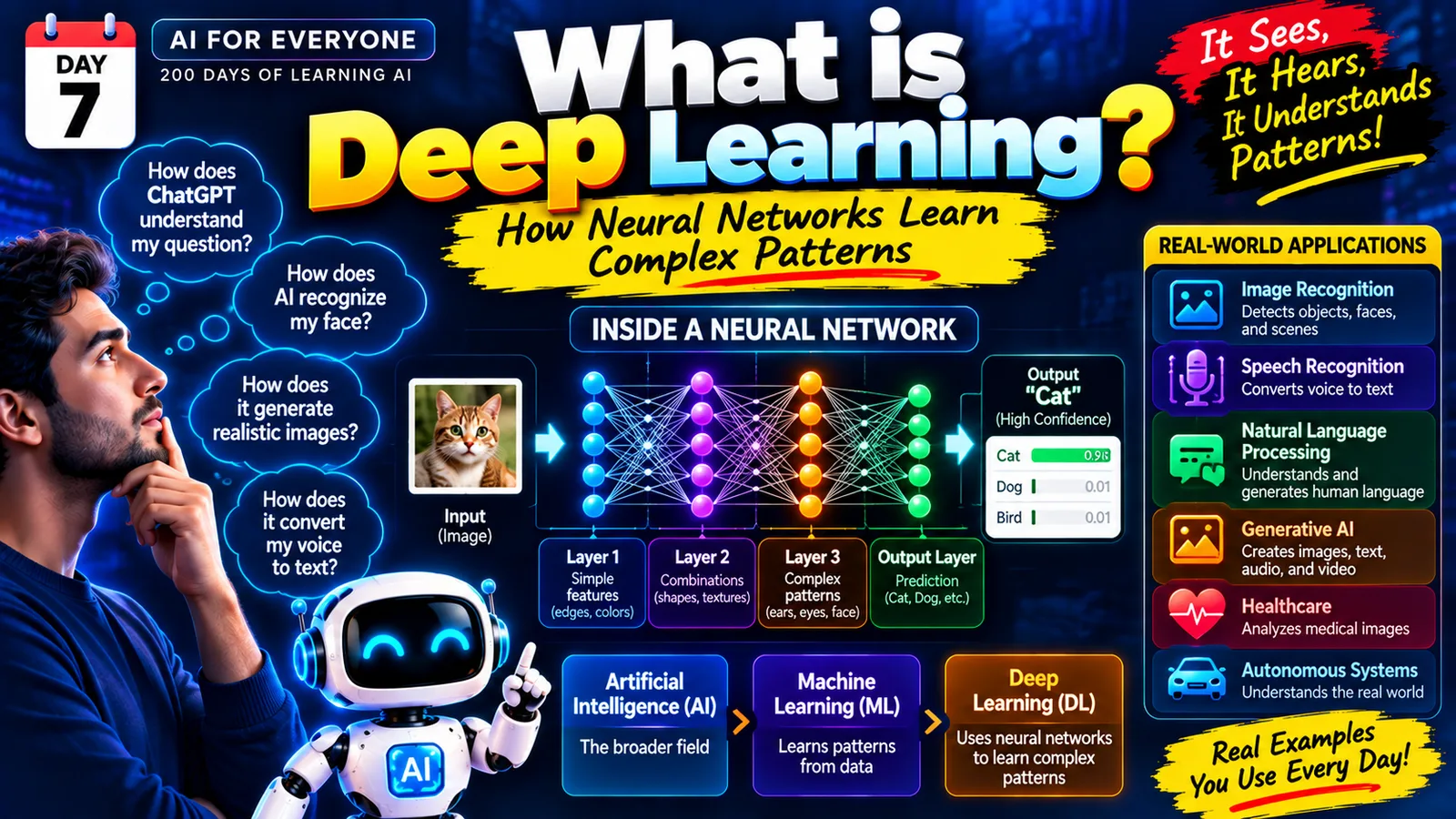
AI for Everyone — Day 7 of 200
How can an AI system recognize objects in a photograph, convert speech into text, translate languages, or generate a realistic image from a text prompt?
Behind many of these capabilities is a technology called Deep Learning.
Deep Learning has become one of the most important areas of modern artificial intelligence. It powers many image recognition systems, speech technologies, language models, and generative AI applications.
But the terminology can be confusing. What is Deep Learning? How is it different from Machine Learning? What are neural networks? And why does Deep Learning require so much data and computing power for some tasks?
In this beginner-friendly guide, we'll answer these questions using simple analogies, practical examples, and real-world applications.
1. What Is Deep Learning?
Deep Learning is a branch of Machine Learning that uses neural networks with multiple layers to learn complex patterns from data.
Instead of requiring developers to define every pattern manually, a Deep Learning model can learn useful representations from training examples by adjusting its internal parameters.
For example, consider an application that recognizes handwritten digits.
A developer could attempt to write rules for every possible way a person might write the number 7. But handwriting varies significantly between people.
A Deep Learning model can learn patterns from many labeled examples and use those patterns to recognize digits it hasn't seen before.
Deep Learning is especially useful for complex data such as images, audio, video, and natural language.
However, it isn't the best solution for every problem. Simpler algorithms can perform very well on many structured business datasets.
2. Understand AI vs. Machine Learning vs. Deep Learning
These terms are related, but they don't mean the same thing.
| Technology | Meaning | Example |
|---|---|---|
| Artificial Intelligence | The broader field of creating systems that perform tasks associated with intelligence | A rule-based decision system or an AI assistant |
| Machine Learning | Techniques that learn patterns from data | Predicting customer churn |
| Deep Learning | Machine Learning using neural networks with multiple layers | Recognizing objects in images |
The relationship is:
Artificial Intelligence → Machine Learning → Deep Learning
This is a simplified hierarchy of the fields, not a claim that every AI system uses Machine Learning.
A practical analogy
Imagine you're building a system to identify defective products in a factory.
-
AI describes the broader goal of making the inspection system perform an intelligent task.
-
Machine Learning describes an approach that learns from examples of defective and non-defective products.
-
Deep Learning is one possible Machine Learning approach that can learn complex visual patterns from product images.
The correct choice depends on the problem, the data, the accuracy requirements, the cost of errors, and available computing resources.
3. What Is an Artificial Neural Network?
A neural network is a computational model made up of connected units commonly called neurons.
These units process inputs, apply mathematical operations, and pass information through the network. During training, the network adjusts its parameters to improve its predictions.
The term neural network was inspired by biological nervous systems, but artificial neural networks are mathematical and computational systems. They are not exact replicas of the human brain.
A typical feedforward neural network has three broad types of layers.
Input layer
The input layer receives the data.
For an image classification model, the input might be numerical values representing image pixels. For a text model, the input may be a sequence of tokens represented numerically.
Hidden layers
Hidden layers transform the incoming information. With training, different layers can learn representations that help the model solve its task.
In an image recognition model, early layers may respond to simple visual patterns, while deeper layers may represent more complex shapes or combinations of features.
This is an intuitive description; the exact representations depend on the model architecture and training process.
Output layer
The output layer produces the model's result.
Depending on the task, the result might be:
-
Probabilities for several image categories
-
A predicted numerical value
-
A sequence of generated tokens
-
A classification score
Key idea: Deep Learning uses multiple layers of learned transformations to represent increasingly complex relationships in data.
4. How Does Deep Learning Actually Work?
Let's understand the process using an example: building a model that recognizes cats and dogs in images.
Step 1: Collect training data
You gather a suitable collection of cat and dog images.
For supervised image classification, the training examples need labels that indicate the correct category.
The dataset should include enough relevant variation to support the intended use case, such as different breeds, lighting conditions, backgrounds, and camera angles.
Poor-quality or unrepresentative data can limit the model's performance.
Step 2: Prepare the data
Images may need to be resized, normalized, checked for corrupted files, and converted into a format the model can process.
The dataset is usually divided into training, validation, and test sets.
-
Training set: Used to learn model parameters.
-
Validation set: Used during development to compare configurations and make modeling decisions.
-
Test set: Used to evaluate the final model on held-out data.
Keeping these roles separate helps prevent overly optimistic evaluation results.
Step 3: Pass data through the neural network
The model processes the input and produces a prediction.
For example, it might assign a higher score to the cat category than to the dog category.
At first, a randomly initialized model may produce poor predictions.
Step 4: Calculate the loss
A loss function measures how far the model's prediction is from the target according to a chosen mathematical objective.
For example, if the correct label is “cat” but the model assigns it a low probability, the loss may indicate that the prediction should improve.
The precise loss function depends on the task.
Step 5: Update the model parameters
Training algorithms use gradients to determine how the parameters should change to reduce the loss.
Two important concepts are:
-
Backpropagation: Calculates gradients of the loss with respect to the model's parameters.
-
Optimization: Uses those gradients to update the parameters, commonly through methods such as stochastic gradient descent or Adam.
The model repeats this process over many training examples.
Step 6: Evaluate the model
After training, evaluate the model on data that was not used to fit its parameters.
For a classification problem, useful measures may include accuracy, precision, recall, and a confusion matrix. The correct metrics depend on the consequences of different errors.
For example, in a quality inspection system, missing a dangerous defect may be much more costly than incorrectly flagging a good product.
Step 7: Deploy and monitor
Once validated, the model can be integrated into an application or service.
After deployment, developers should monitor latency, resource usage, data changes, and model performance where ground-truth outcomes are available.
Real-world conditions can change, so a model that worked well during testing may need further evaluation or retraining.
5. What Is the Difference Between Training and Inference?
These two terms are fundamental to understanding modern AI systems.
Training is the process of adjusting a model's parameters using data and a learning objective.
Inference is the process of using a trained model to produce an output for new input.
Consider a photo recognition application.
-
During training, the model learns from a collection of labeled images.
-
During inference, the application sends a new photo to the trained model and receives its prediction.
Training can be computationally expensive, particularly for large Deep Learning models. Inference costs vary according to model size, hardware, input length, throughput, and latency requirements.
For developers integrating existing AI APIs, inference is often the operation they use directly. The provider may handle training and hosting behind the scenes.
6. Real-World Applications of Deep Learning
Deep Learning is used across many industries. Here are several important applications.
Computer vision
Computer vision systems analyze images and video.
Examples include:
-
Detecting objects in photographs
-
Identifying defects on manufacturing lines
-
Reading text from documents
-
Supporting medical image analysis
-
Understanding scenes in autonomous driving systems
Deep Learning can learn complex visual features that are difficult to describe through manually written rules alone.
Speech recognition
Speech recognition systems convert spoken language into text.
Applications include voice typing, meeting transcription, call-center analytics, and voice-controlled software.
Performance can depend on accents, background noise, language coverage, recording quality, and the model's training data.
Natural language processing
Deep Learning models can process and generate human language.
Examples include:
-
Language translation
-
Text classification
-
Document summarization
-
Question answering
-
Information extraction
-
Conversational assistants
Modern language models use neural network architectures that learn statistical relationships in large collections of data.
Generative AI
Generative AI models create new content, such as text, images, audio, video, or code.
Many modern generative AI systems use Deep Learning. Large language models, for example, are trained on sequences of tokens and can generate responses based on the input and context they receive.
Generative models can produce incorrect information, so their outputs should be evaluated according to the application's risk and reliability requirements.
Healthcare
Deep Learning can support medical image analysis, research, and certain clinical decision-support tasks.
These applications require careful validation, attention to patient privacy, and appropriate professional oversight. A model's performance in a research dataset does not automatically establish that it is safe for every clinical setting.
Manufacturing
Factories can use Deep Learning for visual inspection, equipment monitoring, and certain predictive maintenance tasks.
The business objective is not simply to achieve a high model score. It is to reduce defects, improve reliability, or support better operational decisions while accounting for false alarms and missed detections.
7. Why Is Deep Learning So Powerful?
Deep Learning has several important strengths.
It can learn complex representations. Multiple layers can transform raw data into useful patterns without requiring developers to manually define every feature.
It works with many data types. Neural networks can be designed for images, text, audio, time series, and other data.
It can scale with data and computation. For many tasks, increasing model capacity, training data, and computing resources can improve performance, although gains are not guaranteed.
It supports modern generative AI. Deep Learning architectures are central to many systems that generate text, images, audio, and code.
These strengths make Deep Learning valuable, but they do not eliminate the need for good data, careful evaluation, and responsible deployment.
8. What Are the Limitations of Deep Learning?
Deep Learning also comes with significant challenges.
Large data requirements
Some models require large quantities of high-quality training data. Labeling that data can be costly or time-consuming.
Some techniques can learn from unlabeled data or work with smaller datasets, but their effectiveness depends on the task and method.
Computing costs
Training large neural networks can require specialized hardware and substantial energy. Serving large models can also be expensive at scale.
Smaller models, pretrained models, model compression, and managed AI services can help reduce costs.
Overfitting
Overfitting occurs when a model learns patterns specific to its training data that do not generalize well to new examples.
Separate validation and test data, regularization, suitable model selection, and representative datasets help address this problem.
Limited interpretability
Some neural networks are difficult to interpret compared with simpler models.
For high-stakes applications, teams may need additional evaluation, explainability techniques, human oversight, and stronger governance.
Bias and data quality
If training data contains systematic biases or does not represent the intended users and conditions, model performance may be uneven.
Testing should examine relevant groups, scenarios, and failure cases rather than relying only on a single aggregate score.
Reliability
A model can make confident but incorrect predictions. Deep Learning outputs should not be treated as automatically correct simply because the model is sophisticated.
9. Deep Learning vs. Traditional Machine Learning
Deep Learning is a subset of Machine Learning, but it is not always the best choice.
| Factor | Traditional Machine Learning | Deep Learning |
|---|---|---|
| Model types | Decision trees, linear models, gradient-boosted trees, and others | Neural networks with multiple layers |
| Data preparation | Often relies on carefully designed features for certain tasks | Can learn useful features directly from raw data in many applications |
| Structured business data | Often highly competitive and efficient | Can work well, but may require more tuning and data |
| Images, audio, and complex language | Can be used, but may require specialized feature engineering | Often highly effective with suitable architectures and data |
| Computing needs | Often modest for smaller models | Can be substantial, especially for large models |
| Interpretability | Depends on the algorithm; some models are easier to explain | Many complex neural networks are harder to interpret |
For a small business application that predicts whether a customer will renew a subscription, a gradient-boosted tree or logistic regression model may be a sensible starting point.
For an application that interprets complex images or processes natural language, Deep Learning may be a better fit.
Always compare approaches using realistic data, appropriate metrics, operational constraints, and the cost of mistakes.
10. How Can .NET Developers Get Started With Deep Learning?
You can learn Deep Learning concepts while continuing to work with C#, ASP.NET Core, and the .NET ecosystem.
A practical path is to start with the fundamentals, experiment with pretrained models, and integrate a suitable model into an application.
Step 1: Understand the foundations
Learn:
-
Training data and inference
-
Features and labels
-
Neural networks and layers
-
Loss functions and optimization
-
Training, validation, and testing
-
Overfitting and model evaluation
You can understand these concepts without beginning with advanced mathematics.
Step 2: Explore pretrained models
A pretrained model has already learned from a training process. Depending on its license and supported runtime, you may be able to use it without training a large network yourself.
Examples include models for image classification, text embeddings, speech recognition, and language processing.
Check the model's licensing, data requirements, inference costs, and supported deployment environment before using it commercially.
Step 3: Explore the .NET ecosystem
.NET developers can investigate several options:
-
ML.NET: A machine learning framework for building and integrating supported ML scenarios into .NET applications.
-
ONNX Runtime: A runtime for running compatible models in supported environments, including .NET applications.
-
Cloud AI services: Managed services that expose capabilities such as vision, speech, and language processing through APIs.
-
AI model APIs: Hosted models that applications can call for text generation, embeddings, and other supported tasks.
These options serve different needs. ML.NET is not a universal framework for training every modern Deep Learning architecture, and not every model can be used directly with every runtime.
Step 4: Build a practical application
A beginner project could be an image classification API.
The application might:
-
Receive an image through an ASP.NET Core endpoint.
-
Validate the request and file type.
-
Preprocess the image according to the model's requirements.
-
Run inference using a compatible model.
-
Return the predicted category and relevant scores.
-
Log operational metrics without unnecessarily storing sensitive images.
For production, also consider request limits, model-loading strategy, inference latency, concurrency, security, and monitoring.
Step 5: Evaluate before deployment
Test the model with realistic examples, including edge cases.
Measure not only predictive performance but also latency, memory use, throughput, and failure behavior.
A model that performs well in a notebook may require substantial engineering before it is suitable for a production API.
11. A Beginner's Learning Roadmap
Follow this sequence to build a solid foundation.
Stage 1 — AI fundamentals
-
Artificial Intelligence vs. Machine Learning vs. Deep Learning
-
Data, models, and predictions
-
Training vs. inference
Stage 2 — Machine Learning fundamentals
-
Supervised and unsupervised learning
-
Classification and regression
-
Training and test datasets
-
Evaluation metrics
Stage 3 — Neural networks
-
Neurons and layers
-
Weights and biases
-
Activation functions
-
Loss functions
-
Backpropagation and optimization
Stage 4 — Deep Learning applications
-
Computer vision
-
Speech recognition
-
Natural language processing
-
Generative AI
Stage 5 — Application development
-
Pretrained models
-
Model inference
-
APIs and application integration
-
Performance, security, and monitoring
You do not need to master every advanced topic before building your first small project. Learn a concept, apply it, evaluate the result, and then progress to the next one.
12. Frequently Asked Questions
What is Deep Learning in simple words?
Deep Learning is a type of Machine Learning that uses neural networks with multiple layers to learn complex patterns from data.
Is Deep Learning the same as AI?
No. AI is the broader field. Deep Learning is a subset of Machine Learning, which is itself a branch of AI.
Is ChatGPT based on Deep Learning?
Yes. Modern large language models use Deep Learning. They are trained neural networks designed to process and generate sequences of tokens.
Does Deep Learning always require GPUs?
No. Small models can run on CPUs. GPUs and other accelerators can make training or inference much faster for suitable workloads, especially for large models.
Is Deep Learning difficult to learn?
It can become mathematically and technically demanding, but beginners can start with the concepts, visual examples, and pretrained models before studying the advanced mathematics.
Can Deep Learning be used in .NET applications?
Yes. Depending on the model and deployment requirements, .NET applications can use ML.NET, ONNX Runtime, cloud AI services, or hosted model APIs.
Is Deep Learning always better than traditional Machine Learning?
No. Traditional ML can be more practical for many structured-data problems, particularly when data or computing resources are limited. Choose based on measured performance and the requirements of the application.
Conclusion: Understand the Technology Behind Modern AI
Deep Learning is one of the key technologies behind modern image recognition, speech processing, language models, and generative AI.
Remember these essential ideas:
-
Neural networks process data through connected computational layers.
-
Training adjusts model parameters to improve performance against a learning objective.
-
Inference uses a trained model to produce predictions or generate outputs.
-
Deep Learning can learn complex patterns, but it also brings costs, reliability challenges, and data requirements.
-
The best model is the one that meets the real application's requirements—not necessarily the largest or most complex one.
You do not need to understand every equation to start learning AI. Build your foundation one concept at a time and connect each concept to a practical application.
Continue your AI learning journey:
Explore more technology guides at https://toolliyo.com.
For mentorship and career guidance, visit https://topmate.io/sandeeppal.
Coming next — Day 8: What Are Neural Networks? The Technology Behind Modern AI.
AI for Everyone — 200 Days of Learning AI, One Concept at a Time.