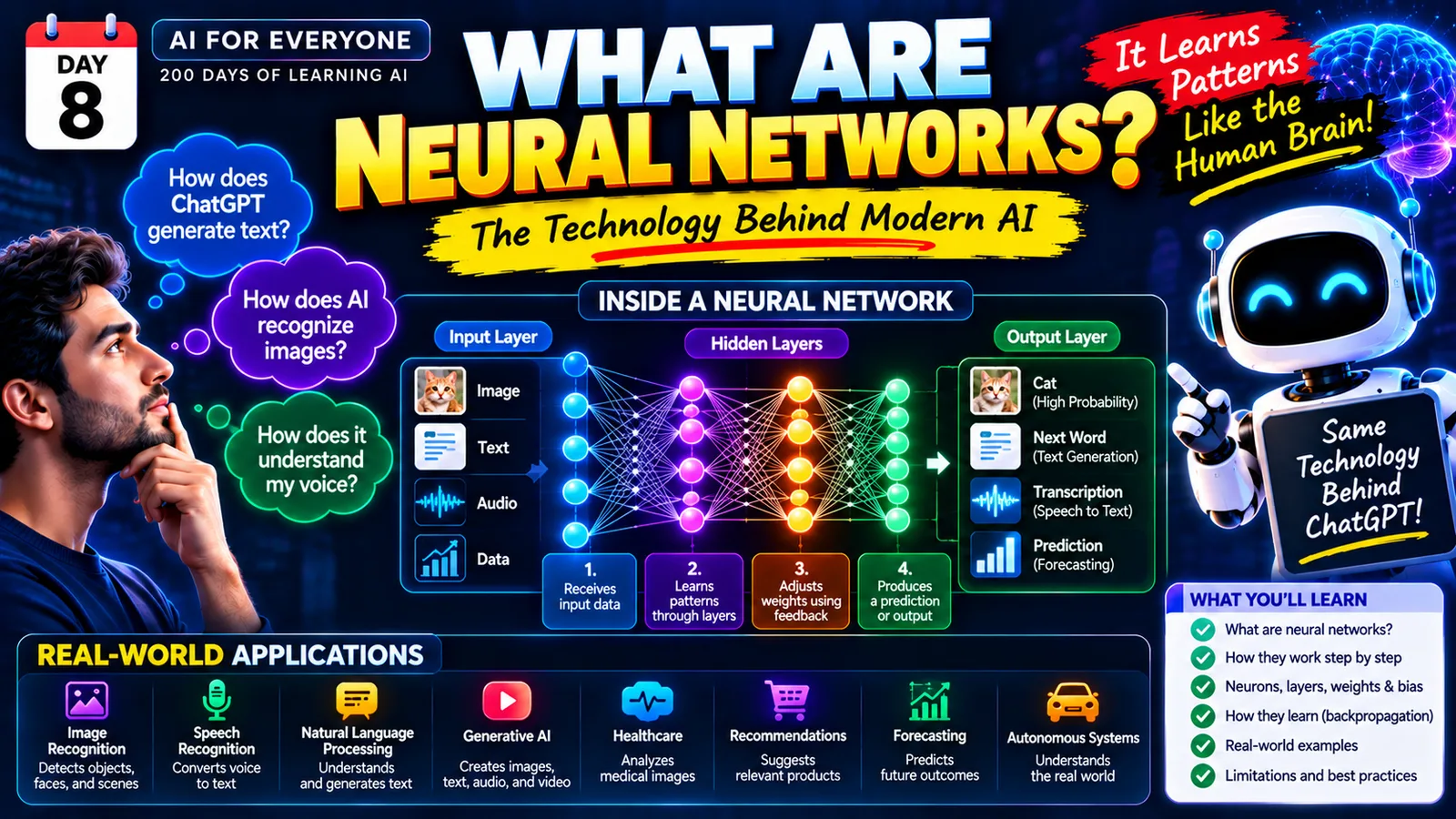
AI for Everyone — Day 8 of 200
How can an AI model recognize a cat in a photograph, generate a paragraph of text, translate a sentence, or recognize spoken words?
One important technology behind many of these capabilities is the artificial neural network.
Neural networks are computational models that learn patterns from data. They are a core component of Deep Learning and power many modern AI applications, including image recognition, speech processing, and large language models.
But how do they actually work? What are neurons, layers, weights, biases, and activation functions? And how does a neural network learn from its mistakes?
In this beginner-friendly guide, we'll explore these concepts step by step, using simple analogies and practical examples.
1. What Is a Neural Network?
An artificial neural network is a computational model made of interconnected units called neurons. These units process numerical inputs and pass information through the network.
During training, the network adjusts its parameters to learn patterns that help it perform a particular task.
For example, suppose you want to build an application that distinguishes cats from dogs.
Instead of manually writing rules for every possible animal appearance, you can train a neural network using images and their correct labels. The model learns statistical patterns from those examples and uses them to make predictions about new images.
Neural networks can be used for many tasks, including:
-
Image and object recognition
-
Speech recognition
-
Natural language processing
-
Forecasting and prediction
-
Recommendation systems
-
Generative AI
A neural network does not think exactly like a human brain. The name is inspired by biological neural systems, but artificial neural networks are mathematical models implemented in software and hardware.
2. How Does a Neural Network Work?
Imagine a factory inspection system that must determine whether a product is defective.
The system receives an image, processes visual information, and produces a prediction.
A simplified neural network has three major components.
Input layer
The input layer receives the data.
For an image model, the input could be numerical pixel values. For a text model, the input may be tokens represented as numbers. For a forecasting model, the input could include historical measurements.
The network cannot directly understand an image or sentence in the way a human does. The data must first be represented in a form the model can process.
Hidden layers
Hidden layers transform information as it moves through the network.
Each layer applies mathematical operations using learned parameters. Deeper networks can learn increasingly complex representations, depending on their architecture and training.
In an image recognition model, some layers may respond to edges or textures, while later layers may represent more complex combinations of visual features.
This is a simplified illustration. The exact behavior depends on the model design and the data.
Output layer
The output layer produces the result required by the task.
Examples include:
-
A prediction that an image contains a cat
-
A probability or score for a category
-
A numerical forecast
-
A sequence of tokens generated by a language model
The output layer is designed according to what the model needs to predict or generate.
3. Understanding Neural Networks Through a Simple Analogy
Imagine you're teaching someone to identify ripe apples.
You show them many apples and point out useful characteristics, such as color, texture, and other visible signs.
Over time, they learn which combinations of characteristics are associated with ripe apples.
A neural network learns in a different, mathematical way, but the analogy helps illustrate the main idea.
-
Input: Information about the apple.
-
Processing: Mathematical transformations combine relevant signals.
-
Prediction: The model estimates whether the apple is ripe.
-
Feedback during training: The prediction is compared with the training target.
-
Parameter updates: The learning algorithm adjusts the model to improve its predictions.
The network doesn't automatically understand the concept of ripeness as a human would. It learns patterns that help it predict the supplied target.
That distinction matters: a model may learn misleading correlations if the training data is poor or biased.
4. What Are Neurons, Weights, and Biases?
To understand how neural networks work, start with three fundamental concepts.
A. Neurons
An artificial neuron receives numerical inputs, combines them mathematically, and applies an activation function.
A simplified neuron can be represented as:
Output = Activation(weighted inputs + bias)
This means the neuron combines its inputs using weights, adds a bias, and passes the result through an activation function.
A single neuron is simple. Connecting many neurons in layers allows a network to represent more complex relationships.
B. Weights
Weights determine how strongly individual inputs contribute to a neuron's calculation.
For example, imagine a simplified model predicting house prices from several features. The learned weights influence how the model uses information such as floor area or property age.
In a neural network, weights are learned from data during training rather than manually specified for every prediction.
C. Biases
A bias is an additional learned parameter that helps a neuron adjust its activation independently of the weighted input sum.
Together, weights and biases give a network flexibility to learn useful mathematical relationships.
5. What Are Activation Functions?
Without suitable nonlinear operations, stacking multiple linear transformations would still be equivalent to a single linear transformation.
Activation functions introduce nonlinearity, allowing neural networks to learn more complex relationships.
Common activation functions include:
ReLU (Rectified Linear Unit): Commonly used in hidden layers. It returns zero for negative inputs and passes positive inputs through.
Sigmoid: Maps a value to a range between zero and one. It is used in some binary classification outputs and other settings.
Softmax: Converts a set of scores into values that sum to one. It is commonly used to represent class probabilities in certain classification models.
The correct activation function depends on the model architecture and task.
You do not need to memorize every formula before beginning. First understand why neural networks use activation functions: they help the model represent nonlinear patterns.
6. How Does a Neural Network Learn?
A neural network typically learns through a training process that repeatedly evaluates predictions and adjusts model parameters.
Let's use an image classifier that identifies cats and dogs.
Step 1: Prepare the training data
Collect images and their correct labels.
The dataset should represent the conditions in which the model is expected to work. If every cat image has a white background and every dog image has a green background, the model might learn background differences rather than reliable animal features.
Step 2: Initialize the parameters
The network begins with initial weights and biases. These parameters are commonly initialized using methods designed to support effective training.
At the beginning, the model may make poor predictions.
Step 3: Perform a forward pass
The input moves through the network, and the model calculates a prediction.
For example, the model may assign scores to the cat and dog categories.
Step 4: Calculate the loss
A loss function measures how well the prediction matches the target according to the training objective.
If the model assigns a low score to the correct category, the loss may indicate a poor prediction.
The loss function provides a mathematical signal used during training.
Step 5: Use backpropagation
Backpropagation calculates gradients that indicate how the loss changes with respect to the network's parameters.
These gradients help determine how the parameters should be adjusted to reduce the loss.
Step 6: Update the parameters
An optimization algorithm uses the gradients to update the weights and biases.
This process repeats over many examples and training iterations. As training progresses, the model can learn parameters that improve its performance on the training objective.
Step 7: Evaluate on unseen data
A model that performs well on training examples may still fail on new data.
Use separate validation and test datasets to assess generalization. Select evaluation metrics that match the real problem and the cost of different errors.
Important: A lower training loss does not automatically mean the model will perform well in the real world.
7. What Is the Difference Between Training and Inference?
These terms describe two different stages in a model's lifecycle.
Training is the process of learning model parameters from data.
Inference is the process of using a trained model to produce an output for new input.
Consider a photo recognition application.
During training, the network learns from a dataset of labeled images. During inference, the application sends a new photo to the trained model and receives its prediction.
For developers building applications with AI APIs, inference is often the operation they interact with directly. The service provider may manage the model's training and hosting.
Training and inference also have different resource requirements. Training may require repeated processing of large datasets, while inference performance depends on model size, hardware, request volume, and latency targets.
8. What Is the Difference Between a Neural Network and Deep Learning?
These terms are related but not identical.
A neural network is a type of computational model.
Deep Learning is a branch of Machine Learning that uses neural networks with multiple layers to learn complex representations.
A network with only a small number of layers is still a neural network, but the term Deep Learning is generally associated with networks that have greater depth or more elaborate architectures.
Deep Learning models can have many layers and millions or billions of parameters, although model size varies considerably.
The main idea is that deeper networks can learn complex representations from data, provided that the architecture, training process, and dataset are appropriate for the task.
9. What Types of Neural Networks Are Commonly Used?
Different architectures are designed to handle different kinds of data and tasks.
Feedforward neural networks
Information flows from input to output without recurrent connections in the basic architecture.
They are used in a range of prediction tasks and are often a useful starting point for understanding neural networks.
Convolutional Neural Networks (CNNs)
CNNs use convolutional operations to process spatial patterns and have been widely used in computer vision.
Applications include image classification, object detection, and visual inspection.
Recurrent Neural Networks (RNNs)
RNNs process sequences using recurrent connections that carry information across steps. They have been used for sequence modeling, including some language and time-series tasks.
Many modern applications use alternative architectures for these problems, but RNNs remain important for understanding the development of sequence models.
Transformers
Transformers use attention mechanisms to process relationships between elements in a sequence or other structured inputs.
They are central to many modern large language models and are also used in vision, audio, and multimodal systems.
Autoencoders
Autoencoders learn to encode input data into a representation and reconstruct the input from that representation.
Depending on the design and training setup, they can be used for representation learning, dimensionality reduction, and certain anomaly detection tasks.
These architectures are not interchangeable. The best choice depends on the data, task, performance requirements, and deployment environment.
10. How Do Neural Networks Power Modern AI?
Neural networks are a core technology behind many modern AI applications.
Chatbots and language models
Large language models use neural networks to process text and generate sequences of tokens.
They learn statistical patterns from training data and use the supplied context to produce outputs. They can be useful for drafting, summarization, question answering, coding assistance, and other tasks, but they can also generate incorrect information.
Image recognition
Neural networks can learn visual representations that help systems identify objects, classify images, and analyze scenes.
Applications include manufacturing inspection, document processing, and some medical imaging workflows.
Speech recognition
Neural networks support systems that convert speech into text, recognize spoken commands, and process audio.
Performance can depend on recording quality, language, accent, background noise, and the model's training data.
Recommendation systems
Some recommendation systems use neural networks to learn representations of users, products, or interactions.
These representations can help estimate which products, videos, or other items may be relevant to a user.
Not all recommendation systems require Deep Learning; simpler methods can also be effective.
Generative AI
Generative AI systems use models that create new content, including text, images, audio, video, and code.
Many modern generative models are based on neural networks. Their capabilities depend on the model architecture, training process, and how the system is integrated into an application.
11. What Are the Limitations of Neural Networks?
Neural networks are powerful, but they introduce important challenges.
Data requirements: Many tasks need substantial amounts of representative training data. Some architectures and techniques can work effectively with less data, but requirements vary.
Computational cost: Large networks can require specialized hardware and significant energy for training or serving.
Overfitting: A model may learn details specific to its training data and fail to generalize. Suitable validation, regularization, and dataset design can help.
Bias: If the training data reflects systematic biases, the model may reproduce or amplify them.
Interpretability: Complex networks can be difficult to explain. Some applications need additional evaluation, explainability methods, or human oversight.
Reliability: Neural networks can produce incorrect predictions, even when they appear confident. High-stakes applications require rigorous testing and safeguards.
Understanding these limitations is part of building responsible AI systems.
12. How Can .NET Developers Work With Neural Networks?
You do not need to build and train a large neural network from scratch to integrate AI into a .NET application.
Several approaches are available, depending on your use case.
Option 1: Use a hosted AI model API
An ASP.NET Core application can call an external AI service to access capabilities such as text generation, embeddings, speech, or image analysis.
This can be a practical way to add AI functionality without managing model training infrastructure.
Consider API costs, rate limits, latency, data privacy, and provider dependencies.
Option 2: Use ONNX Runtime
ONNX Runtime can run compatible models in supported environments, including .NET applications.
This approach may suit scenarios where you want to execute a compatible model within your own application infrastructure.
You must verify that the model's operators, input and output formats, and runtime requirements are supported.
Option 3: Explore ML.NET
ML.NET is a machine learning framework for .NET developers. It supports several machine learning workflows and can be useful for learning concepts such as classification and regression.
It is not a universal replacement for every modern Deep Learning framework or architecture, so choose the tool based on the model and task.
A practical project idea
Build an image classification API with ASP.NET Core.
The application can:
-
Receive an image upload.
-
Validate the file and request size.
-
Prepare the image in the format required by the model.
-
Run inference using a compatible model.
-
Return the predicted category and relevant scores.
-
Record performance metrics and handle failures safely.
For production, also consider authentication, request limits, concurrency, model loading, monitoring, and the handling of potentially sensitive images.
13. A Beginner's Roadmap for Learning Neural Networks
If you want to understand neural networks without becoming overwhelmed, follow this progression.
Stage 1: AI and Machine Learning fundamentals
-
Understand AI vs. Machine Learning vs. Deep Learning.
-
Learn what data, models, training, and inference mean.
Stage 2: Neural network basics
-
Inputs and outputs
-
Neurons and layers
-
Weights and biases
-
Activation functions
Stage 3: The learning process
-
Forward propagation
-
Loss functions
-
Backpropagation
-
Optimization
-
Training and validation
Stage 4: Explore architectures
-
Feedforward networks
-
CNNs
-
RNNs
-
Transformers
Stage 5: Build a practical application
-
Start with a pretrained model.
-
Run inference.
-
Integrate it into an API.
-
Evaluate results and monitor performance.
You can learn the concepts gradually. Start with a small experiment and build your understanding through practice.
14. Frequently Asked Questions
What is a neural network in simple words?
A neural network is a computational model made of connected units that transform data and learn patterns by adjusting internal parameters during training.
Is a neural network the same as Deep Learning?
Not exactly. A neural network is a type of model, while Deep Learning refers to Machine Learning approaches that use neural networks with multiple layers.
How do neural networks learn?
They make predictions, calculate a loss, compute gradients through backpropagation, and update parameters using an optimization algorithm. Repeating this process helps the model learn patterns from data.
Are neural networks used in ChatGPT?
Yes. Modern large language models use neural networks, typically based on transformer architectures, to process and generate text.
Do neural networks work like the human brain?
They were inspired in part by biological neural systems, but artificial neural networks are mathematical models and do not reproduce the brain's full structure or functioning.
Can C# developers build AI applications with neural networks?
Yes. C# developers can integrate hosted AI APIs, run compatible models with ONNX Runtime, and use ML.NET for supported machine learning scenarios.
Conclusion
Neural networks are a foundational technology behind many modern AI applications.
Remember these key concepts:
-
Neurons perform mathematical computations.
-
Weights and biases are learned parameters.
-
Layers transform information.
-
Loss functions measure prediction errors according to a learning objective.
-
Backpropagation and optimization help the model update its parameters.
-
Training learns parameters; inference uses a trained model to produce outputs.
You do not need to memorize every equation before building AI applications. Understand the components, experiment with a small model, and gradually explore more advanced architectures.
The goal is not just to use AI tools. It is to understand the technology well enough to build, evaluate, and integrate AI systems responsibly.
Continue your AI learning journey
Explore more practical AI and developer guides at https://toolliyo.com.
For mentorship and career guidance, visit https://topmate.io/sandeeppal.
Coming next — Day 9: What Is Natural Language Processing (NLP)? How AI Understands Human Language.
AI for Everyone — 200 Days of Learning AI, One Concept at a Time.