Imagine your company uses an AI assistant.
It can answer general questions, summarize documents, and generate content. However, your business needs something more specific.
You want the AI to:
-
Follow your company's communication style.
-
Classify customer complaints into predefined categories.
-
Generate responses in a consistent format.
-
Understand specialized terminology.
-
Perform a particular task more consistently.
Should you build a completely new AI model?
Usually, no.
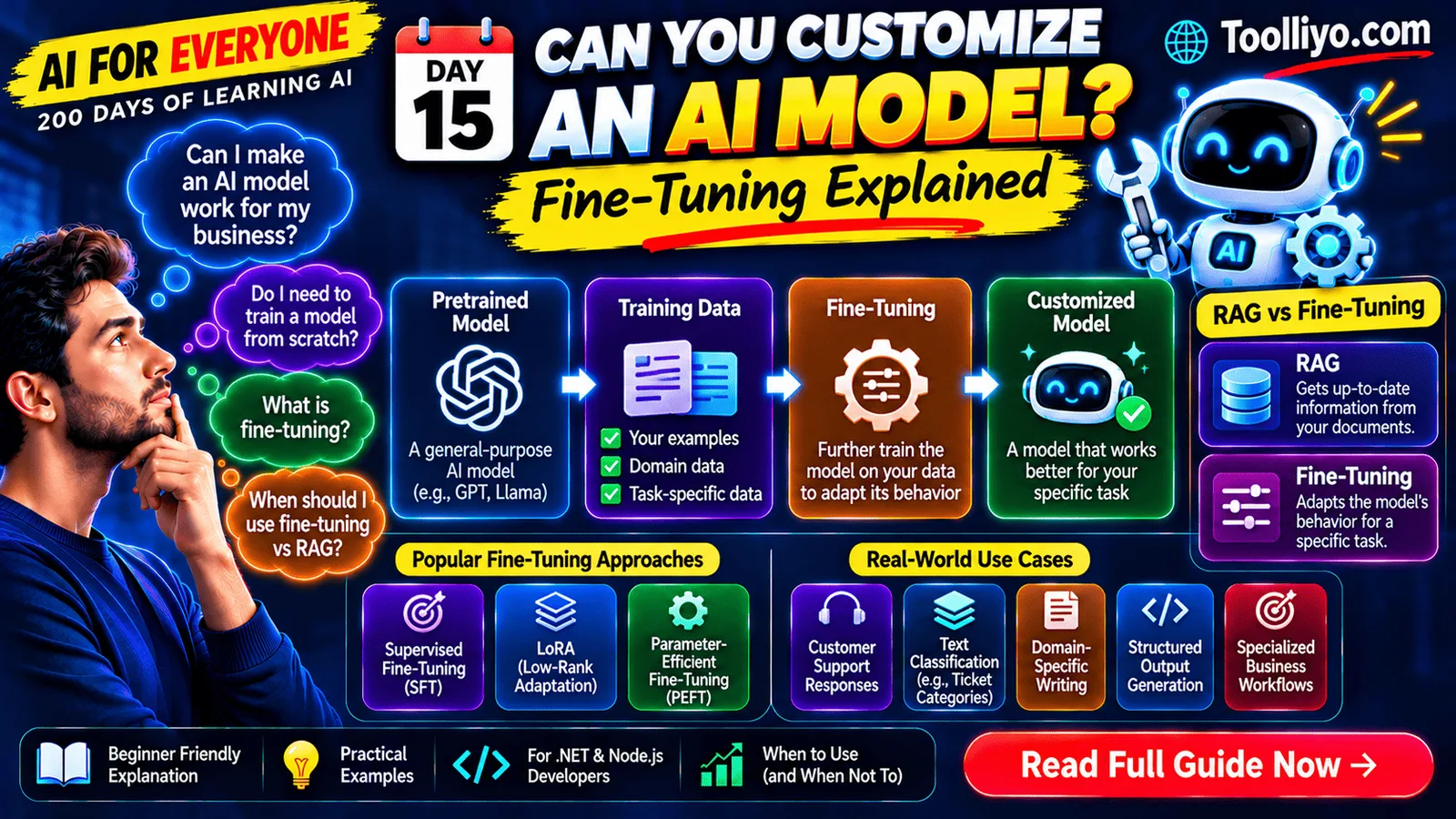
You can start with an existing pretrained model and adapt it using a technique called Fine-Tuning.
Fine-tuning is an important concept in modern AI engineering because it allows developers and organizations to customize suitable pretrained models for specialized tasks.
In this guide, you'll learn what fine-tuning is, how it works, what types exist, when to use it, and how it differs from RAG.
1. What Is Fine-Tuning in AI?
Fine-tuning is the process of taking an already-trained machine learning model and training it further on an additional dataset to adapt it to a particular task or domain.
Let's understand this with an example.
Imagine you have a pretrained language model that can understand and generate general-purpose text.
Your company wants to use it for customer support.
You have thousands of historical support conversations showing:
-
Customer questions.
-
Complaint categories.
-
Approved responses.
-
Escalation requirements.
-
Preferred communication style.
You can prepare a suitable training dataset and use a supported fine-tuning method to adapt an eligible model.
The resulting model may become better suited to your particular task.
The important idea: You are not starting from zero. You are building on knowledge and capabilities learned during the model's original training.
Fine-tuning does not guarantee better performance. Its effectiveness depends on the base model, training data, task, training method, and evaluation process.
2. What Is a Pretrained Model?
Before understanding fine-tuning, you need to understand pretraining.
A pretrained model is a model that has already been trained on a substantial dataset.
For example, a language model may have learned patterns related to:
-
Language and grammar.
-
Relationships between words.
-
General knowledge patterns.
-
Text generation.
-
Programming concepts.
-
Different writing styles.
The exact capabilities depend on the model and its training process.
Instead of training a language model from scratch, developers can start with a suitable pretrained model.
Think of it like hiring an experienced employee who already has general knowledge and training them on your company's specific processes.
The employee doesn't need to learn everything from the beginning. They need additional training for the role.
Similarly, fine-tuning adapts an existing model to a more specific requirement.
3. How Does Fine-Tuning Work?
Let's understand the process using a customer-support classification example.
Your company receives messages such as:
-
"I cannot log into my account."
-
"My payment was deducted twice."
-
"I want to cancel my subscription."
-
"The application crashes when I open it."
You want the model to classify these messages into:
-
Authentication.
-
Payment.
-
Subscription.
-
Technical Issue.
A simplified fine-tuning workflow looks like this.
Step 1: Select a pretrained model
Choose a model that supports your intended task and fine-tuning method.
Consider its capabilities, licensing, deployment requirements, supported languages, and cost.
Step 2: Prepare the training dataset
Create examples containing inputs and their expected outputs.
For example:
Input:
"I cannot log into my account."
Expected output:
"Authentication"
Another example:
Input:
"My payment was deducted twice."
Expected output:
"Payment"
The dataset should contain representative examples of the situations the model will encounter.
Step 3: Clean and validate the data
Remove duplicates, incorrect labels, irrelevant examples, and sensitive information that should not be included.
Check that the examples are consistent and representative.
Step 4: Format the dataset
Different model providers and training frameworks require different data formats.
Some use structured conversation examples, while others support task-specific input-output formats.
Follow the requirements of the selected model and training method.
Step 5: Train or fine-tune the model
The training process uses the additional examples to adjust model parameters or a supported subset of parameters.
The exact process depends on the model architecture and fine-tuning technique.
Step 6: Evaluate the customized model
Test the fine-tuned model using examples it did not see during training.
Check whether it performs better on the intended task.
Step 7: Deploy and monitor
Integrate the model into your application.
Monitor its performance, latency, cost, and failure cases. Retrain or revise the dataset when requirements change.
The simplified workflow is:
Pretrained Model → Training Dataset → Fine-Tuning → Evaluation → Customized Model → Deployment
4. What Are the Different Types of Fine-Tuning?
Fine-tuning is not a single technique. Several approaches are used depending on the model, resources, and objective.
1. Supervised Fine-Tuning (SFT)
Supervised fine-tuning trains a pretrained model using examples of desired inputs and outputs.
For example:
Input: "Explain dependency injection in simple words."
Expected output: A clear beginner-friendly explanation.
The model learns to produce responses more aligned with the examples.
Common applications include:
-
Instruction following.
-
Specialized classification.
-
Response formatting.
-
Domain-specific assistance.
-
Task-specific generation.
2. Full Fine-Tuning
In full fine-tuning, the training process updates the model's trainable parameters across the model rather than only a small subset.
This can provide substantial flexibility but may require considerable GPU memory, computational resources, and training expertise.
It is not automatically the best approach for every use case.
3. Parameter-Efficient Fine-Tuning (PEFT)
Parameter-Efficient Fine-Tuning adapts a model while training a smaller set of parameters rather than updating all model parameters.
This can reduce training resource requirements.
One popular family of techniques is LoRA.
4. LoRA (Low-Rank Adaptation)
LoRA is a parameter-efficient fine-tuning technique.
Instead of updating the original model weights directly in the usual full-training manner, LoRA introduces smaller trainable low-rank matrices into selected model layers.
These additional parameters learn task-specific adjustments.
Benefits can include:
-
Lower training memory requirements.
-
Fewer trainable parameters.
-
Easier experimentation with task-specific adaptations.
-
The ability to keep the original model weights unchanged.
LoRA is particularly useful when working with supported open-weight models and resource constraints.
5. Preference-Based Alignment
Some model customization workflows use preference data to encourage a model to produce responses that better match human or organizational preferences.
For example, reviewers may compare two responses and indicate which one is better.
Methods such as Direct Preference Optimization (DPO) can use preference datasets to optimize model behavior.
This is more specialized than basic supervised fine-tuning and requires appropriate training support.
Note: These techniques are not interchangeable. Choose the approach based on the model, objective, available data, and training infrastructure.
5. What Is the Difference Between Fine-Tuning and Training From Scratch?
These approaches have very different resource requirements.
| Feature | Training from scratch | Fine-tuning |
|---|---|---|
| Starting point | Randomly initialized or newly defined model | Existing pretrained model |
| Training data | Usually very large and task-dependent | Additional task-specific dataset |
| Resources | Often extremely high | Depends on model and method; can be lower |
| Main objective | Learn capabilities from the training data | Adapt existing capabilities |
| Complexity | Very high | Generally lower |
| Typical use | Foundation model development | Specialized model customization |
For most application developers and smaller organizations, using a suitable existing model is more practical than training a foundation model from scratch.
6. Fine-Tuning vs RAG: What Should You Choose?
This is one of the most important decisions in AI application development.
Fine-tuning and Retrieval-Augmented Generation solve different problems.
Scenario A: Your AI must answer questions using company documents
Your organization updates its policies every month.
You want the AI assistant to answer questions using the latest approved policies.
Recommended starting point: RAG.
RAG retrieves relevant information from the document collection and supplies it to the model at query time.
You can update the knowledge base without retraining the entire language model, provided your ingestion and indexing processes are maintained.
Scenario B: Your AI must follow a consistent response style
Your company wants support messages to follow a particular structure and tone.
You have a high-quality dataset of approved input-output examples.
Possible solution: Fine-tuning.
Fine-tuning may help adapt the model's behavior to the desired patterns.
However, prompting and structured outputs may be sufficient, so evaluate those options first.
Scenario C: Your AI needs specialized behavior and private knowledge
Your application must follow a particular response style while answering questions using changing company documents.
Possible solution: Combine Fine-Tuning and RAG.
Fine-tuning can adapt supported model behavior, while RAG provides relevant information from the knowledge base.
Comparison table
| Requirement | RAG | Fine-Tuning |
|---|---|---|
| Use changing external documents | Strong fit | Not its primary purpose |
| Adapt response behavior | Prompting and context can help | Can help with consistent task behavior |
| Retrieve private information | Yes, through controlled retrieval | Not automatically |
| Update knowledge | Update the indexed sources | Additional training may be required for new learned behavior |
| Specialized output patterns | Can use prompts and schemas | Can adapt model behavior |
| Reduce unsupported answers | Can supply evidence | Does not inherently provide source evidence |
A useful decision rule:
-
Need access to external or changing knowledge? Start with RAG.
-
Need a more specialized model behavior? Evaluate fine-tuning.
-
Need both? Consider combining them.
-
Need a simpler solution? Try prompting and application logic first.
7. When Should You Fine-Tune an AI Model?
Fine-tuning can be useful when you have a clearly defined task and sufficient high-quality examples.
Consider these scenarios.
Customer support classification
A company wants to classify thousands of customer messages into predefined categories.
A fine-tuned model may learn the organization's classification patterns.
Consistent response generation
A business wants generated responses to follow a specific style and structure.
Fine-tuning may help when prompting alone does not achieve sufficient consistency.
Specialized terminology
A model may need to work with specialized terminology or domain-specific patterns.
Fine-tuning can help adapt its behavior when the training data represents those patterns effectively.
Structured task outputs
An organization may want consistent task-specific output formats.
However, if strict machine-readable output is the main requirement, schema-constrained generation and validation may be simpler and more reliable than fine-tuning.
Domain-specific text processing
Fine-tuning may improve performance on specialized classification, extraction, or transformation tasks when suitable training examples are available.
8. When Should You NOT Fine-Tune?
Fine-tuning is not the default solution for every AI problem.
Avoid it when:
-
You only need to add a few instructions to a prompt.
-
You need to search frequently changing documents.
-
You don't have enough reliable training examples.
-
You haven't defined how success will be measured.
-
Your application can solve the task with deterministic business logic.
-
The model or provider does not support your required training method.
-
The operational cost is greater than the expected benefit.
For example, suppose you want an AI assistant to answer questions about a product catalog that changes daily.
Fine-tuning the model on the entire catalog may create unnecessary maintenance work.
A retrieval-based solution is often a better starting point.
9. What Is the Fine-Tuning Dataset?
A fine-tuning dataset contains examples used to adapt a model.
The structure depends on the model and training method.
For a simple classification task, you might have:
| Input | Expected output |
|---|---|
| I cannot sign in | Authentication |
| My card was charged twice | Payment |
| I want to stop my subscription | Subscription |
| The app crashes on startup | Technical Issue |
For a conversational model, the dataset may contain user messages and ideal assistant responses.
What makes a good dataset?
A useful dataset should be:
-
Relevant to the intended task.
-
Consistent in formatting.
-
Correctly labeled.
-
Representative of real-world inputs.
-
Diverse enough to cover important scenarios.
-
Free from unnecessary duplication.
-
Reviewed for privacy and sensitive information.
Training, validation, and test data
Do not evaluate a model only on examples it has already seen.
Separate your data into appropriate sets:
Training set: Used to update the model.
Validation set: Used during development to compare configurations and monitor training.
Test set: Reserved for evaluating performance on unseen examples.
The exact split depends on the dataset size and task. Avoid data leakage between these sets.
10. What Are Epochs, Batch Size, and Learning Rate?
When studying fine-tuning, you'll frequently encounter these training terms.
Epoch
An epoch is one complete pass through the training dataset.
For example, training for three epochs means the training process makes three passes through the dataset, subject to the training configuration.
More epochs do not automatically produce better results.
Too many can cause overfitting.
Batch size
Batch size is the number of training examples processed together in a training step.
It influences memory usage and optimization behavior.
Learning rate
The learning rate controls the size of parameter updates during optimization.
A learning rate that is too high may destabilize training, while one that is too low may result in slow or ineffective learning.
These settings should be selected and evaluated using the chosen training method.
11. What Is Overfitting?
Overfitting happens when a model adapts too closely to the training examples and performs poorly on new, unseen examples.
Imagine training a support classification model using only 100 examples with very repetitive wording.
The model may perform well on similar examples but struggle when customers describe the same issue differently.
This is why evaluation on unseen examples is essential.
Ways to reduce overfitting include:
-
Improving dataset diversity.
-
Removing duplicated or incorrect examples.
-
Using appropriate regularization.
-
Monitoring validation performance.
-
Selecting suitable training configurations.
-
Evaluating on realistic, unseen data.
Fine-tuning should improve generalization to the intended task, not simply memorize training examples.
12. How Developers Can Use Fine-Tuned Models
You do not need to build a foundation model to integrate a fine-tuned model into your application.
If a model provider supports fine-tuning, you may be able to submit a training dataset, run a supported training job, and use the resulting model through an API.
The exact process and available model options vary by provider.
For .NET developers
A typical architecture might look like this:
-
React frontend collects the user input.
-
ASP.NET Core Web API validates the request.
-
Backend calls the selected fine-tuned model through its supported API.
-
Backend validates and processes the response.
-
API returns the result to the frontend.
Your backend should manage authentication, rate limits, retries, timeouts, logging, and usage tracking.
For Node.js developers
The same approach works with Node.js.
The backend sends validated input to the selected model API and processes the generated response.
Keep API credentials server-side and apply appropriate authorization and validation.
Important distinction
Using a fine-tuned model in an application is called inference.
Fine-tuning is the additional training process that creates or adapts the model.
Your production API does not need to retrain the model for every incoming request.
13. Common Fine-Tuning Mistakes
Mistake 1: Fine-tuning without a clear objective
If you cannot explain what behavior needs to improve, it is difficult to decide whether fine-tuning is appropriate.
Define measurable success criteria first.
Mistake 2: Using poor-quality training data
Incorrect or inconsistent examples can teach the model undesirable patterns.
Review and clean the dataset before training.
Mistake 3: Assuming more training data always means better results
Quality, diversity, and relevance matter. Large quantities of repetitive or incorrect examples can be harmful.
Mistake 4: Ignoring the baseline model
Always evaluate the original model before fine-tuning.
Otherwise, you cannot establish whether the additional training actually improved performance.
Mistake 5: Skipping test data
Evaluate on unseen examples to identify overfitting and generalization problems.
Mistake 6: Fine-tuning to store changing facts
Fine-tuning is not a substitute for a reliable, updateable knowledge-retrieval system.
Use RAG or another appropriate data-access architecture when the application needs changing external information.
Mistake 7: Ignoring privacy and licensing
Training data may contain personal, confidential, or licensed information.
Ensure that its use is authorized and complies with applicable privacy, contractual, and provider requirements.
14. Frequently Asked Questions
Is fine-tuning the same as training an AI model?
Not exactly. Fine-tuning continues training an existing pretrained model. Training from scratch starts without the same pretrained parameters.
Does fine-tuning require Python?
Many training frameworks and workflows use Python, but developers can integrate supported fine-tuned models into .NET or Node.js applications through APIs. The training language and inference integration language do not have to be the same.
Does fine-tuning remove hallucinations?
No. Fine-tuning does not guarantee factual accuracy. Grounding, retrieval, validation, and evaluation may still be necessary.
Can I fine-tune ChatGPT?
Fine-tuning availability depends on the specific OpenAI models, APIs, and supported training workflows. Not every model or ChatGPT product feature supports the same customization options.
Is LoRA the same as fine-tuning?
LoRA is a parameter-efficient fine-tuning technique. It is one approach to adapting supported models.
Should beginners learn RAG or fine-tuning first?
For developers building business applications that need to answer questions using documents, RAG is often a practical starting point. Learn fine-tuning when you have a specific behavior or task that requires model adaptation.
Conclusion: Customize AI Only When You Have a Clear Reason
Fine-tuning allows developers and organizations to adapt pretrained AI models for specialized tasks.
It can be valuable for classification, consistent response generation, specialized text processing, and other well-defined use cases.
But remember: customization does not always require additional model training.
Sometimes a better prompt, structured output, RAG pipeline, or ordinary application logic is enough.
The best AI engineering decision is not to use the most complicated technique. It is to choose the simplest approach that reliably solves the actual problem.
Your Day 15 action plan:
-
Choose a specific AI task, such as support-ticket classification.
-
Prepare a small collection of correctly labeled examples.
-
Define how you will measure success.
-
Test the original model as a baseline.
-
Explore a supported fine-tuning method.
-
Evaluate the customized model using unseen examples.
-
Compare its quality, cost, and maintenance requirements.
Continue the AI for Everyone series
This is Day 15 of 200 Days of Learning AI.
Tomorrow's lesson: What Is Prompt Engineering? How to Communicate Effectively With AI.
Explore more developer learning resources at Toolliyo.com.
For personalized developer mentorship, visit Topmate.
Keep learning, keep building, and keep experimenting with AI.