Introduction: The Technology Behind Modern AI
Have you ever asked ChatGPT to explain a difficult concept, write an email, generate code, or summarize a long document?
Within seconds, it can produce a response that sounds remarkably human.
But how does this work?
Does ChatGPT search for a ready-made answer in a database? Does it understand language exactly as humans do? Or is something else happening behind the scenes?
The technology behind many modern conversational AI systems is called a Large Language Model (LLM).
LLMs have changed how people interact with computers. They can generate text, answer questions, summarize information, assist with programming, and support applications that work with human language.
In this guide, you'll learn what LLMs are, how they work, why they sometimes make mistakes, and how developers can use them to build practical AI applications.
1. What Is a Large Language Model (LLM)?
A Large Language Model is an AI model trained on large amounts of text and other language data to learn patterns in language and generate or process text.
Let's break down the name.
Large: The model may have a very large number of learned parameters and require substantial computational resources for training and inference.
Language: The model is designed to work with language, including understanding text in context and generating text.
Model: It is a mathematical system whose parameters are adjusted during training to learn patterns from data.
An LLM can use those learned patterns to generate answers, explain concepts, summarize documents, translate text, and assist with code.
A simple example
Suppose you enter this prompt:
"Explain cloud computing to a beginner."
An LLM processes your input and generates a response using its learned patterns and the context available in the conversation.
It doesn't necessarily retrieve a prewritten explanation. It generates a new sequence of tokens in response to your request.
That distinction is central to understanding generative AI.
2. Examples of Large Language Models
Several AI organizations develop language models.
-
OpenAI: GPT model families.
-
Google: Gemini model families.
-
Anthropic: Claude model families.
-
Meta: Llama model families.
-
DeepSeek: DeepSeek model families.
-
Mistral AI: Mistral model families.
These model families differ in their capabilities, cost, speed, context limits, deployment options, and supported features. Their capabilities also vary by specific model and version.
Some models are accessed through hosted APIs, while others can be deployed in environments that provide greater control over infrastructure and data handling.
An important distinction: ChatGPT is an AI product, while GPT refers to a family of models. The product may include additional tools, interfaces, and capabilities beyond the underlying language model.
3. How Does an LLM Actually Work?
Let's follow a simplified example.
You ask:
"Explain machine learning in simple words."
A language model processes your request through several stages.
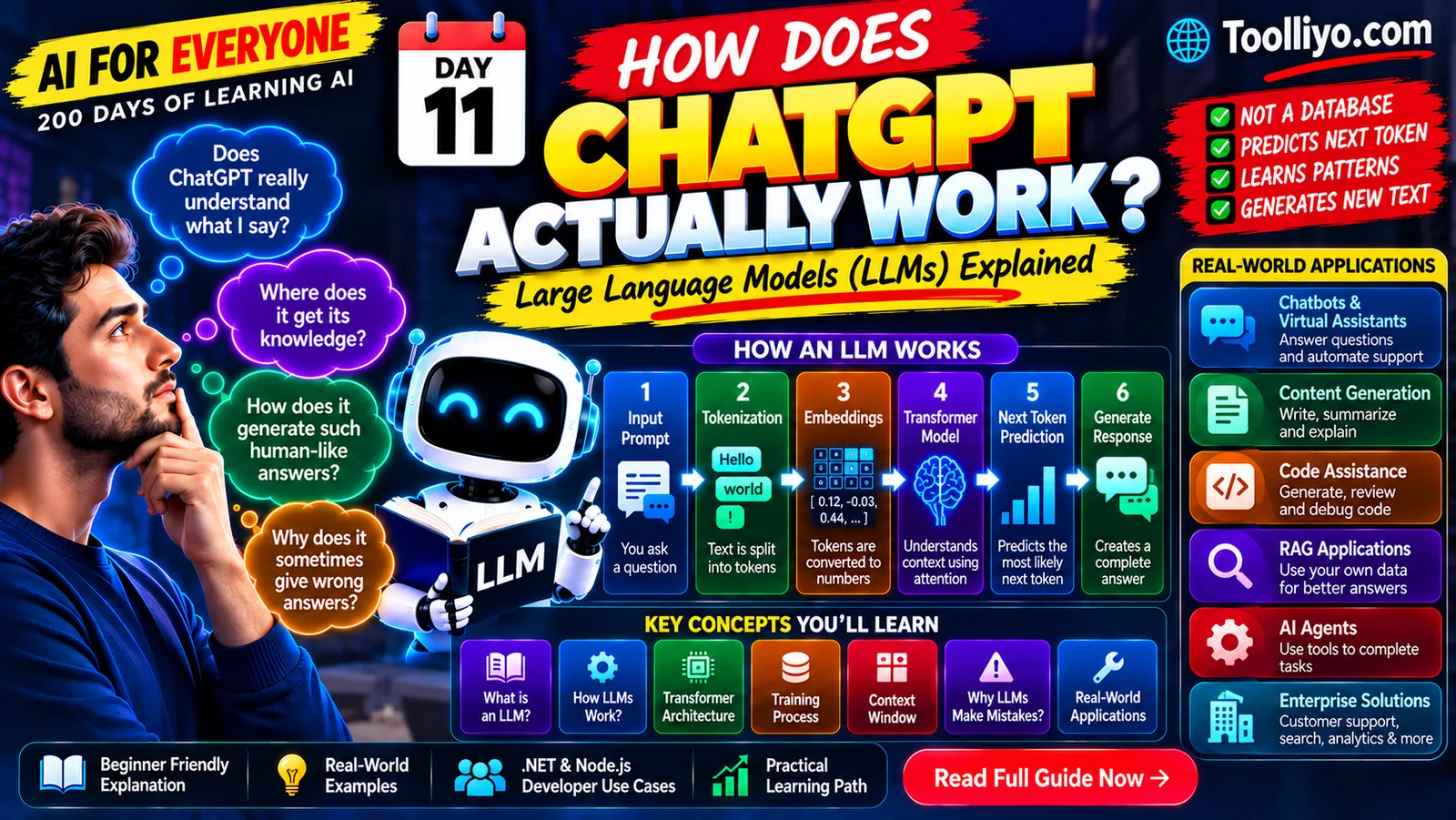
Step 1: Receive the input
Your prompt is sent to the model, often along with system instructions and relevant conversation history.
The complete input available to the model is called its context.
Step 2: Tokenize the text
The input is divided into tokens. A token might represent a word, part of a word, punctuation, or another piece of text.
For example, a tokenizer may divide a sentence into several units rather than assigning one token to each word.
Tokenization is important because language models process token sequences rather than ordinary text directly.
Step 3: Convert tokens into numerical representations
Tokens are mapped to numerical identifiers and then to learned vector representations called embeddings.
These representations allow the model to perform mathematical operations on language inputs.
Embeddings are not simply dictionary definitions. They are learned numerical representations used within the model.
Step 4: Process context and relationships
Many modern LLMs are based on the Transformer architecture.
Transformers use mechanisms such as attention to process relationships between tokens. This helps the model use relevant information from the surrounding context.
For example, the meaning of the word "bank" may depend on whether the surrounding sentence discusses money or a river.
The model uses its learned parameters and input context to calculate representations that help predict what comes next.
Step 5: Predict the next token
A language model produces scores that can be converted into probabilities for possible next tokens.
For example, after:
"The capital of France is..."
the model may assign a high probability to "Paris."
This example illustrates next-token prediction, but it does not mean every model always generates the most probable token or that every prediction is correct.
Step 6: Generate the response
The selected token is added to the output sequence. The model then predicts another token, repeating the process until it reaches a stopping condition.
This is called autoregressive generation in models that generate one token at a time.
The complete process can be summarized as:
Prompt → Tokens → Numerical representations → Context processing → Token prediction → Generated response
This is a simplified explanation. Actual model architectures, training methods, inference strategies, and product integrations can differ.
4. What Is the Transformer Architecture?
The Transformer is a neural network architecture introduced in the 2017 research paper Attention Is All You Need.
It became foundational to many modern language models.
One of its key ideas is the attention mechanism.
Attention allows a model to weigh information from different parts of an input when processing a particular token.
Consider this sentence:
"The developer opened the project because it contained a bug."
To interpret the sentence, a language model must process relationships between words and the surrounding context. Attention mechanisms help the model represent these relationships.
Transformers also use other components, including learned representations, feed-forward neural network layers, and normalization mechanisms.
Why does this matter?
Transformers can process contextual relationships effectively and support large-scale training. However, not every LLM uses an identical architecture, and many production models contain optimizations or additional components.
5. How Are LLMs Trained?
Training is a major part of what makes an LLM useful.
A simplified training process involves several stages.
Stage 1: Collect and prepare data
Training datasets may contain text from many sources, subject to the model developer's data collection, licensing, filtering, and privacy practices.
Data preparation can include removing unwanted content, filtering duplicates, and processing text into tokens.
Training data quality matters. Poor-quality or unbalanced data can influence the model's behavior.
Stage 2: Pretraining
During pretraining, the model learns statistical patterns from large datasets.
A common objective is predicting missing or next tokens, depending on the model architecture and training method.
The model adjusts its parameters to improve its predictions across many training examples.
This process requires substantial computation and optimization.
Stage 3: Instruction tuning
A pretrained model may be further trained on examples of instructions and appropriate responses.
This helps it follow user requests more effectively rather than simply continuing arbitrary text.
Stage 4: Alignment and preference training
Some models undergo additional training to make their responses more helpful, reliable, and consistent with intended behavior.
Methods may include human feedback, preference data, or other optimization techniques.
Not all models use the same training pipeline, and model developers do not necessarily disclose every training detail.
Training versus inference
These terms are worth remembering.
-
Training: The process of adjusting model parameters using data.
-
Inference: Using a trained model to produce a prediction or response.
When you submit a question to a hosted chatbot, the service usually performs inference. It is not ordinarily retraining the entire model from scratch for every question.
6. What Are LLM Parameters?
Parameters are learned numerical values inside a model.
During training, optimization adjusts these values so the model can learn patterns from data.
You may hear descriptions such as a model having billions of parameters.
A larger parameter count can indicate a more complex model, but it does not automatically mean the model is better at every task.
Performance also depends on training data, architecture, optimization, inference methods, available tools, and other factors.
For developers selecting a model, benchmark results, real-world testing, latency, cost, and reliability are usually more useful than parameter count alone.
7. What Is a Context Window?
A context window is the amount of input and generated content a model can handle within a particular request or interaction, subject to that model's limits.
It is typically measured in tokens rather than words.
For example, a conversation may contain:
-
System instructions.
-
User questions.
-
Previous conversation messages.
-
Retrieved documents.
-
Tool outputs.
-
The model's generated response.
These elements may all contribute to context usage.
Why does context size matter?
If an application sends a large document, a long conversation, and extensive instructions to a model, the request can consume a substantial number of tokens.
Depending on the model and API, limits may apply to the combined input and output or to specific portions of a request.
A larger context window can help with long documents and extended conversations, but it does not guarantee that every detail will be used correctly.
Developer tip: Send relevant information instead of blindly including an entire database or every historical message in every request.
8. Why Do LLMs Sometimes Give Wrong Answers?
LLMs can produce fluent, convincing answers that contain errors. This behavior is commonly discussed under the term hallucination.
Several factors contribute to this problem.
1. Plausible language is not proof of truth
A model is trained to learn and generate patterns. A response that sounds natural is not necessarily factually correct.
2. The prompt may be ambiguous
If a request lacks important details, the model may interpret it differently from what the user intended.
3. The model may lack current information
A model's training data may not include recent developments. A model without live retrieval or connected tools may not know current facts.
4. The question may require unavailable evidence
A model cannot reliably provide the contents of a private document it has not been given access to.
5. Long contexts can be challenging
Even when information fits within the context window, a model may not use every relevant detail consistently.
How can developers reduce errors?
-
Use retrieval to supply trusted, relevant source material.
-
Ask the model to distinguish evidence from assumptions.
-
Validate structured outputs against a schema.
-
Use deterministic application logic for calculations and business rules.
-
Verify important claims against authoritative sources.
-
Add evaluation tests and production monitoring.
-
Require human review for consequential decisions.
These techniques can improve reliability, but none guarantees that every model response will be correct.
9. What Is the Difference Between an LLM and a Search Engine?
They can both help answer questions, but they work differently.
| Feature | Large Language Model | Search Engine |
|---|---|---|
| Main function | Generates or processes language | Finds and ranks information sources |
| Typical output | An answer, summary, explanation, or generated content | Links and indexed results |
| Source access | Depends on the model and connected tools | Searches an index of available sources |
| Main risk | May generate plausible but incorrect details | May surface outdated or unreliable sources |
| Best use | Drafting, transformation, conversational assistance | Finding sources and checking current information |
These are general distinctions. Modern AI products often combine both approaches.
For example, an AI assistant may search the web, retrieve relevant pages, and then use an LLM to summarize the findings.
10. What Is the Difference Between an LLM and Generative AI?
Generative AI is the broader category of AI systems that generate new content.
That content can include text, images, audio, video, or code.
An LLM is a model specialized in language-related tasks, although many modern systems combine language capabilities with image, audio, or other modalities.
Examples:
-
An LLM generates a technical explanation.
-
An image-generation model creates an illustration from a prompt.
-
An audio model generates speech or transcribes spoken language.
-
A multimodal model may process text and images within the same interaction.
An LLM can be part of a generative AI system, but the terms are not interchangeable.
11. How Can Developers Use LLMs in Real Applications?
LLMs become especially useful when integrated into software systems that provide business logic, data access, security, and user interfaces.
Here are some practical use cases.
AI-powered customer support
An application can use an LLM to draft answers to customer questions, summarize support conversations, or classify incoming requests.
For sensitive actions, the application should enforce permissions and approval rules outside the model.
Document question-answering
A user uploads a document and asks questions about its contents.
A system can extract the text, retrieve relevant sections, and pass those sections to the LLM to generate a grounded response.
This is one common use of Retrieval-Augmented Generation (RAG).
Code assistance
An LLM can explain code, suggest refactoring, generate test cases, and help developers investigate errors.
Generated code still requires review, testing, and security checks.
Intelligent search
An application can combine embeddings, vector search, keyword search, and an LLM to help users find information across large collections of documents.
Workflow automation
An LLM can interpret an incoming request and propose a structured action. The application can then validate the request and execute authorized operations.
The model should not be treated as a replacement for access control, validation, or transactional guarantees.
12. How .NET and Node.js Developers Can Work With LLMs
You do not need to train a massive language model from scratch to build an AI-powered application.
A practical starting point is to use a model API from your existing application stack.
For .NET developers
A common architecture looks like this:
-
A React frontend submits a question.
-
An ASP.NET Core Web API validates the request.
-
The backend calls an LLM provider through an SDK or HTTP API.
-
The backend processes the model response.
-
The API returns the result to the frontend.
Useful areas to learn include:
-
LLM API integration.
-
Dependency injection and configuration.
-
Secure API key management.
-
Asynchronous HTTP requests.
-
Structured output validation.
-
Streaming responses.
-
Retry policies, timeouts, and rate limits.
-
Logging, monitoring, and cost tracking.
The Microsoft ecosystem also offers libraries and services for building AI applications. Choose specific frameworks according to the application's requirements and the provider's current support.
For Node.js developers
A similar architecture can be built with Node.js and an appropriate web framework.
The backend receives a request, validates the input, calls the model API, handles errors, and returns the response.
The same production principles apply: keep API credentials on the server, validate model outputs, enforce authorization, and monitor usage.
What about building your own LLM?
Training a competitive foundation model requires substantial data, specialized expertise, and significant computational resources.
For most application developers, a more practical progression is:
-
Learn to call an existing model.
-
Build a useful application.
-
Add retrieval and grounding.
-
Introduce tools and controlled workflows.
-
Evaluate quality, security, latency, and cost.
-
Consider fine-tuning or specialized deployment when justified by evidence.
This approach focuses on solving real problems instead of rebuilding infrastructure that already exists.
13. Common Myths About LLMs
Myth 1: LLMs always know the correct answer.
Reality: They can produce incorrect or incomplete responses. Important information must be verified.
Myth 2: Every LLM is connected to the internet.
Reality: Internet access depends on the product and its tools. A model does not automatically have live web access.
Myth 3: More parameters always mean better results.
Reality: Model quality depends on many factors beyond size.
Myth 4: LLMs are simply databases of stored answers.
Reality: They learn patterns in their parameters and generate responses from those patterns and the available context. Some systems also use search or retrieval.
Myth 5: Developers must train their own LLM to build AI applications.
Reality: Many useful applications can be built with existing models and well-designed application architecture.
14. Frequently Asked Questions
Is ChatGPT an LLM?
ChatGPT is an AI product that uses language models and may include additional tools and capabilities. GPT refers to a family of models developed by OpenAI.
Do LLMs understand human language?
They can process language contextually and perform many tasks that appear to require understanding. However, their capabilities and limitations differ from human cognition, and fluent responses do not prove human-like understanding.
Can an LLM learn from every conversation?
Not necessarily. Whether conversation data is stored or used for model improvement depends on the product, settings, and provider policies. A conversation does not automatically retrain the underlying model in real time.
Can I build an AI chatbot using .NET?
Yes. An ASP.NET Core backend can call an LLM API and provide responses to a frontend such as React. You should implement authentication, input validation, error handling, and appropriate data protection.
Are LLMs going to replace software developers?
LLMs can automate or accelerate parts of software development, but production software still requires requirements analysis, architecture, debugging, testing, security, and accountability. Developers who learn to use AI effectively can apply it as a tool rather than relying on generated output blindly.
Conclusion: Understand the Model, Then Build Something Useful
Large Language Models are a major foundation of modern generative AI.
They learn patterns from training data, process input through learned representations, and generate responses using token prediction and other model-specific techniques.
But building useful AI products requires more than knowing how a model works. Developers must also understand data retrieval, application security, output validation, cost management, evaluation, and monitoring.
Your Day 11 action plan:
-
Ask an LLM to explain a topic you already understand.
-
Ask it to summarize the same topic for a beginner.
-
Compare the answers and verify any factual claims.
-
Identify one repetitive task in your work that an LLM could assist with.
-
Consider how you could integrate that capability into a real application.
Start small. Test carefully. Build something useful.
Continue the AI for Everyone series
This is Day 11 of 200 Days of Learning AI.
Tomorrow's lesson: What Are AI Embeddings? How AI Converts Meaning Into Numbers.
Explore more developer learning resources at Toolliyo.com.
Looking for personalized developer mentorship? Visit Topmate.
Keep learning, keep building, and keep experimenting with AI.