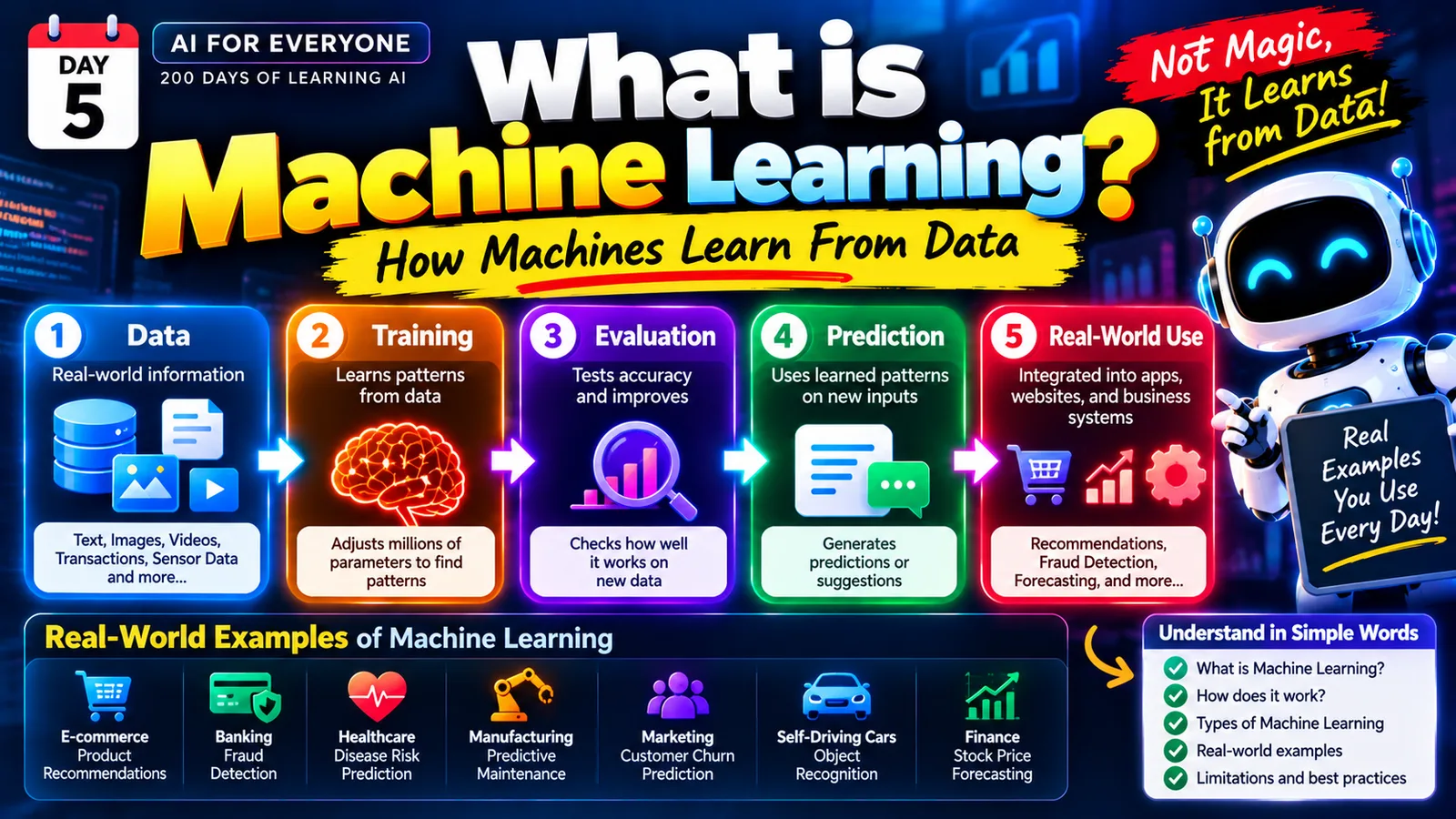
Introduction: How Can Machines Learn Without Being Programmed for Every Situation?
Imagine you are building an application that predicts house prices.
You know that the price of a house can depend on its location, size, number of bedrooms, age, and other factors.
You could try to write a rule for every possible combination.
But what happens when the market changes? What if two houses of the same size have very different prices because they are in different locations?
Writing and maintaining rules for every situation can quickly become difficult.
What if, instead, you could provide historical house-price data to a computer and let it learn useful patterns?
That is the basic idea behind Machine Learning.
Machine Learning enables computer systems to learn patterns from data and use those patterns to make predictions or decisions.
It is one of the most important branches of Artificial Intelligence and powers many applications we use every day.
In this guide, you'll learn how Machine Learning works, the major types of ML, practical business applications, its limitations, and how to start learning it.
No advanced mathematics is required to understand the fundamentals.
1. What Is Machine Learning?
Machine Learning (ML) is a branch of Artificial Intelligence that uses algorithms to learn patterns from data and apply those patterns to new situations.
Instead of manually programming every decision rule, developers provide data and choose a suitable learning method.
The training process produces a model that can make predictions or perform another defined task.
For example, a Machine Learning model can be trained to:
-
Predict house prices.
-
Identify suspicious banking transactions.
-
Recommend products.
-
Estimate customer churn.
-
Classify emails as spam or legitimate.
-
Forecast sales.
-
Recognize patterns in images.
The model does not automatically understand every factor behind its predictions. It learns patterns according to its training process, available data, and learning objective.
Its predictions must be evaluated to determine whether they are useful.
A simple analogy: Learning to recognize spam emails
Imagine receiving thousands of emails.
Some are genuine messages, while others are spam.
You could write rules such as:
-
Flag emails from known malicious senders.
-
Flag messages containing specific suspicious phrases.
-
Flag emails matching particular patterns.
But spammers continually change their tactics. Maintaining all these rules becomes difficult.
A Machine Learning system can learn from examples of spam and legitimate emails.
During training, it adjusts its parameters to improve its ability to distinguish between the two categories.
When a new email arrives, the trained model predicts whether it is likely to be spam.
It can make mistakes, but it may recognize patterns beyond the exact examples it was trained on.
The key idea: Machine Learning helps systems generalize from examples rather than relying exclusively on manually written rules.
2. How Does Machine Learning Work?
A typical Machine Learning project follows several stages.
Step 1: Define the problem
Before collecting data, decide what you want the model to accomplish.
For example:
"Predict the likely selling price of a house based on its characteristics."
This is a prediction problem in which the target is a numerical value.
A different problem might be:
"Predict whether a customer will cancel a subscription."
That is a classification problem if the target is represented by categories such as cancel or not cancel.
Clearly defining the problem helps determine which data, model, and evaluation metrics are appropriate.
Step 2: Collect relevant data
For a house-price prediction model, the dataset might include:
-
Property size.
-
Location.
-
Number of bedrooms.
-
Property age.
-
Historical sale price.
The historical sale price is the target the model will learn to predict.
Data should be relevant to the intended use. Incorrect records, missing values, biased samples, or outdated information can reduce the quality of the results.
Step 3: Prepare the data
Raw data often requires cleaning and transformation.
This may involve:
-
Handling missing values.
-
Correcting inconsistent records.
-
Removing duplicates where appropriate.
-
Converting categories into suitable representations.
-
Identifying unusual values.
-
Selecting useful features.
For example, if one record expresses house size in square feet and another uses square metres, the units must be handled consistently.
Data preparation is often a substantial part of real Machine Learning projects.
Step 4: Split the data
A common approach is to divide the dataset into training and testing portions, sometimes using a separate validation set as well.
The training data is used to fit the model.
The validation data can help compare models and tune settings.
The testing data provides a more independent assessment of how well the selected model performs on unseen examples.
For time-dependent problems, such as sales forecasting, the split should respect the timeline to avoid accidentally using future information to predict the past.
Step 5: Train the model
A learning algorithm uses the training data to adjust the model's parameters according to a defined objective.
For a house-price model, the process aims to reduce the difference between predicted and actual prices according to the chosen loss function.
The resulting model may learn useful relationships between property features and sale prices.
Step 6: Evaluate the model
After training, test the model on appropriate unseen data.
For price prediction, you might measure the average size of its prediction errors.
For spam detection, you might measure precision, recall, and other classification metrics.
The appropriate metric depends on the problem and the cost of different types of errors.
Step 7: Deploy and monitor the model
If the model meets the requirements, it can be integrated into an application.
For example, an estate agency website might use it to estimate property prices.
Once deployed, its performance should be monitored. Changes in property markets or customer behavior can make previously learned patterns less useful.
Machine Learning is not just about training a model. It also involves problem definition, data preparation, evaluation, deployment, and monitoring.
3. What Are the Three Main Types of Machine Learning?
Machine Learning is commonly introduced through three major approaches:
-
Supervised Learning.
-
Unsupervised Learning.
-
Reinforcement Learning.
They differ primarily in how the learning problem is structured and what kind of feedback the system receives.
A. Supervised Learning
Supervised Learning uses labeled training examples.
A label is the known target associated with an example.
Imagine a dataset containing house sizes, locations, and historical sale prices.
The property information represents the input features. The sale price is the target label.
During training, the model learns relationships between the features and the known prices.
After training, it can estimate prices for houses it has not seen before.
Two common supervised learning tasks are:
Regression: Predicts a numerical value.
Examples include predicting house prices, delivery times, and monthly sales.
Classification: Predicts a category.
Examples include classifying emails as spam or legitimate and identifying whether a transaction requires fraud review.
Supervised Learning is particularly useful when suitable labeled historical data is available.
B. Unsupervised Learning
Unsupervised Learning works with data that does not have predefined target labels for the learning task.
The goal may be to discover structure, relationships, or groups within the data.
Imagine an online retailer with customer purchase histories but no predefined customer segments.
A clustering algorithm might group customers based on similarities in their purchasing behavior.
The retailer could then examine whether those groups correspond to useful business segments.
Other unsupervised techniques can help identify patterns, reduce dimensionality, or explore data structure.
However, a discovered cluster does not automatically have a meaningful business interpretation. People often need to examine and validate the results.
Unsupervised Learning is useful when you want to explore data and discover patterns without specifying a target answer for each example.
C. Reinforcement Learning
Reinforcement Learning (RL) focuses on learning how to select actions through interaction with an environment.
An agent observes a situation, chooses an action, and receives feedback in the form of a reward or penalty signal.
Over time, a suitable learning process can improve the agent's strategy for achieving a goal.
Imagine training an agent to play a game.
It tries different moves. Some moves lead to better outcomes than others. Reward signals help the agent learn which strategies are more effective.
Reinforcement Learning has applications in game-playing research, robotics, control problems, and other settings where sequential decisions matter.
It is different from simply providing a collection of labeled examples because the learning process involves actions and feedback from an environment.
We'll explore these three approaches in more detail in Day 6 of this series.
4. What Is the Difference Between AI and Machine Learning?
Artificial Intelligence is the broader field. Machine Learning is one approach within it.
Not every AI system uses Machine Learning.
A rule-based system can make decisions using explicitly programmed conditions.
For example, an application might reject an order when its payment status is invalid or prevent a purchase from exceeding an approved spending limit.
These decisions can be implemented using conventional software rules.
A Machine Learning system, on the other hand, can estimate whether a transaction is suspicious by learning patterns from historical examples.
The two approaches can work together.
A banking application might use a Machine Learning model to assign a fraud-risk score while conventional business rules enforce transaction limits and approval requirements.
This combination allows each component to perform the task it is best suited for.
5. Machine Learning vs Deep Learning
Deep Learning is a subset of Machine Learning that uses neural networks with multiple layers to learn complex patterns.
Machine Learning includes a much wider range of approaches, such as linear regression, decision trees, clustering algorithms, and neural networks.
Consider two problems.
Problem 1: Predicting customer churn from structured business data
A model might use subscription history, usage frequency, account age, and customer-service interactions.
A conventional Machine Learning method such as gradient-boosted trees may be a strong candidate.
Problem 2: Recognizing objects in photographs
A Deep Learning model may be well suited to processing image data and learning complex visual representations.
These examples are illustrative rather than universal rules. The right approach depends on the dataset, problem, constraints, and available tools.
Deep Learning can require substantial computational resources and training data, although pretrained models and modern techniques can reduce the effort needed for many applications.
Remember: Deep Learning is part of Machine Learning, but Machine Learning is not limited to Deep Learning.
6. Real-World Machine Learning Examples
Machine Learning is used across many industries. Here are some practical examples.
Banking and finance
Models can analyze transaction patterns and identify activity that deserves further investigation.
For example, a transaction that differs significantly from a customer's usual behavior may receive a higher fraud-risk score.
The score is not proof of fraud. Additional checks or human review may be required.
E-commerce
Recommendation systems can estimate which products may interest a customer based on available behavioral and product information.
For example, a customer who frequently purchases running shoes may receive recommendations for sports socks or fitness accessories.
Healthcare
Machine Learning can support selected risk-prediction, medical-image analysis, and administrative tasks.
Medical applications require appropriate validation, privacy protections, and professional oversight.
Manufacturing
Predictive maintenance models can analyze sensor readings and historical equipment failures to estimate the risk of a future breakdown.
The goal is to help teams investigate problems before equipment fails, rather than relying exclusively on fixed maintenance schedules.
Marketing
A company can use Machine Learning to estimate which customers may stop using a service.
The business can then investigate the underlying causes and decide whether appropriate retention measures are worthwhile.
Weather and demand forecasting
Forecasting models can help estimate future demand, inventory needs, or other time-dependent quantities.
Their performance depends on the available data, the forecasting horizon, and changing conditions.
These examples demonstrate that Machine Learning is not limited to chatbots or generative AI. It is also widely useful for prediction, classification, ranking, and pattern discovery.
7. What Are Features, Labels, Models, and Predictions?
These four terms appear frequently in Machine Learning discussions.
Features: The input variables used by a model.
For a house-price model, features might include property size, location, and number of bedrooms.
Labels: The known target values associated with training examples in supervised learning.
For the same model, the historical sale price is the label.
Model: The learned function or system that transforms input information into an output.
Prediction: The output produced when the model processes an input.
For example, suppose a trained model receives information about a house and estimates its price at ₹75 lakh.
The property characteristics are the features, the historical prices were labels during training, the trained system is the model, and ₹75 lakh is its prediction.
The estimate may be useful, but it should not be treated as a guaranteed market price.
Understanding these terms makes Machine Learning tutorials and technical documentation much easier to follow.
8. Why Do Machine Learning Models Make Mistakes?
Machine Learning models are not perfect. Several problems can affect their performance.
Poor-quality data
Incorrect values, missing information, or inconsistent records can make learning more difficult.
Insufficiently representative data
A model trained on one population or environment may perform poorly when used in a substantially different setting.
Overfitting
A model may learn the training examples too closely and fail to generalize to new data.
Underfitting
A model may be too simple, poorly configured, or insufficiently trained to capture the patterns needed for the task.
Data leakage
Information that would not genuinely be available at prediction time can accidentally enter training or evaluation, creating misleadingly strong results.
Changing real-world conditions
Customer behavior, market prices, and other underlying patterns can change over time. This is often described as data drift or concept drift, depending on what changes.
How can developers reduce these problems?
Developers can improve reliability by:
-
Defining the problem clearly.
-
Preparing and validating data carefully.
-
Using appropriate training, validation, and test procedures.
-
Choosing evaluation metrics that reflect the real cost of errors.
-
Checking for bias and data leakage.
-
Monitoring the model after deployment.
-
Updating the model or system when evidence shows that it is necessary.
A model that performs well during development is not automatically reliable forever.
9. Can You Build a Machine Learning Application Without Being a Research Scientist?
Yes.
You can begin learning Machine Learning by using established libraries and pretrained models rather than implementing every algorithm from scratch.
For example, you could build:
-
A house-price prediction tool.
-
A customer-churn prediction system.
-
A product recommendation prototype.
-
A document classification application.
-
A sales forecasting dashboard.
For software developers, the application often involves more than the model itself.
You may need an API, input validation, data access, logging, model evaluation, monitoring, and a user interface.
A model can generate a prediction, but conventional software is still needed to make that prediction useful and safe within a real application.
What about .NET developers?
You can explore Machine Learning using familiar technologies.
ML.NET is a Machine Learning framework designed for .NET developers. It supports workflows for building, training, and using certain Machine Learning models in .NET applications.
For example, you could investigate a customer-churn classification project or a sales-prediction prototype using C# and ML.NET.
You do not need to abandon your existing backend or full-stack skills to begin exploring Machine Learning.
The important step is to learn the underlying concepts and understand when a particular model is appropriate.
10. A Beginner-Friendly Machine Learning Learning Path
If you are starting from zero, follow this sequence.
Step 1: Learn the fundamentals
Understand AI, Machine Learning, Deep Learning, features, labels, models, training, and inference.
Step 2: Understand basic statistics
Learn averages, distributions, probability, correlation, and how to interpret evaluation metrics.
Step 3: Explore the three major learning approaches
Study supervised, unsupervised, and reinforcement learning.
Step 4: Build a small prediction project
Start with a well-defined problem, such as predicting house prices using an appropriate sample dataset.
Step 5: Learn model evaluation
Understand how to split data, measure performance, detect overfitting, and avoid data leakage.
Step 6: Integrate a model into an application
Expose a model through an API or integrate it into an application workflow.
Step 7: Learn production considerations
Explore monitoring, privacy, security, model maintenance, and the consequences of incorrect predictions.
The goal is not to memorize every algorithm. It is to understand how to choose, evaluate, and apply a suitable method to a real problem.
11. When Should You Use Machine Learning?
Machine Learning is useful when you have a problem that can benefit from patterns learned from data.
Consider these questions before selecting it:
-
Is the problem clearly defined?
-
Is relevant data available?
-
Can you measure whether the model is performing well?
-
Is a learned prediction more useful than a simple rule?
-
What is the cost of a false prediction?
-
Can the model be monitored after deployment?
For example, calculating a fixed tax amount usually requires reliable business logic rather than Machine Learning.
Predicting customer churn may benefit from Machine Learning because customer behavior is complex and varies across individuals.
Choosing the simplest approach that satisfies the requirements is often the best engineering decision.
Final Thoughts
Machine Learning is one of the foundations of modern Artificial Intelligence.
It allows systems to learn patterns from data and apply those patterns to new situations.
From fraud detection and product recommendations to forecasting and image recognition, Machine Learning supports a wide range of practical applications.
But useful Machine Learning requires more than choosing an algorithm.
It requires a well-defined problem, suitable data, appropriate evaluation, reliable integration, and ongoing monitoring.
The real skill is not simply training a model. It is understanding what problem the model should solve, whether its predictions are trustworthy, and how to use its output responsibly.
Start with the fundamentals. Work through small projects. Learn from the results. Gradually move toward more complex applications.
That is how you build a strong foundation in Machine Learning.
Frequently Asked Questions
Is Machine Learning the same as Artificial Intelligence?
No. AI is the broader field, and Machine Learning is one approach within it. Some AI systems use rules or search rather than learning from data.
Does Machine Learning require large amounts of data?
Not always. Data requirements depend on the task, model, data quality, and learning approach. Some simple problems can be addressed with relatively small datasets, while others require substantially more data.
What are the three main types of Machine Learning?
The three commonly introduced approaches are supervised learning, unsupervised learning, and reinforcement learning.
Is Deep Learning a type of Machine Learning?
Yes. Deep Learning is a subset of Machine Learning that uses neural networks with multiple layers.
Can Machine Learning predict the future?
It can estimate future outcomes based on available data and learned patterns. Predictions are uncertain and can become less reliable when conditions change.
Can .NET developers learn Machine Learning?
Yes. .NET developers can explore ML.NET and other suitable tools while applying their existing C# and software engineering skills.
Continue the AI for Everyone Series
This is Day 5 of the 200-Day AI for Everyone Series.
Tomorrow's topic:
Day 6 — Supervised vs Unsupervised vs Reinforcement Learning Explained
We'll compare the three major approaches to Machine Learning with examples, diagrams, and practical use cases.
Explore more technology resources
Visit Toolliyo for developer tutorials, learning resources, and practical technology content:
Get personalized career mentorship
For resume reviews, LinkedIn optimization, interview preparation, and career guidance, connect through Topmate:
Learn AI. Understand AI. Build with AI.
#MachineLearning #ArtificialIntelligence #AIForEveryone #GenerativeAI #Toolliyo