System Design Series — Part 37
Imagine you're scrolling through your Instagram feed.
You like a post.
Your friend refreshes their phone immediately.
For a few seconds...
they still don't see your like.
Did the system lose your data?
No.
The update simply hasn't reached every server yet.
A few moments later...
your like appears everywhere.
This behavior is completely normal in many large-scale distributed systems.
Welcome to the world of BASE Properties.
If ACID is designed for strict consistency, BASE is designed for high availability and massive scalability.
Let's understand it in the simplest way possible.
The Real Problem
Modern applications like:
-
Instagram
-
Facebook
-
X (Twitter)
-
Netflix
-
Amazon
-
YouTube
serve millions of users every second.
Keeping every database perfectly synchronized before responding to users would make these applications much slower.
Instead, many distributed systems choose a different approach.
They prioritize availability and accept that data may take a short time to become consistent.
That's the idea behind BASE.
A Simple Real-World Analogy
Imagine a school notice board.
The principal announces tomorrow is a holiday.
One teacher updates the notice board immediately.
Another classroom hears the news five minutes later.
Eventually, every classroom receives the same information.
The information wasn't wrong.
It simply took time to reach everyone.
That's exactly how BASE works.
What is BASE?
BASE is a consistency model commonly used in distributed databases.
It stands for:
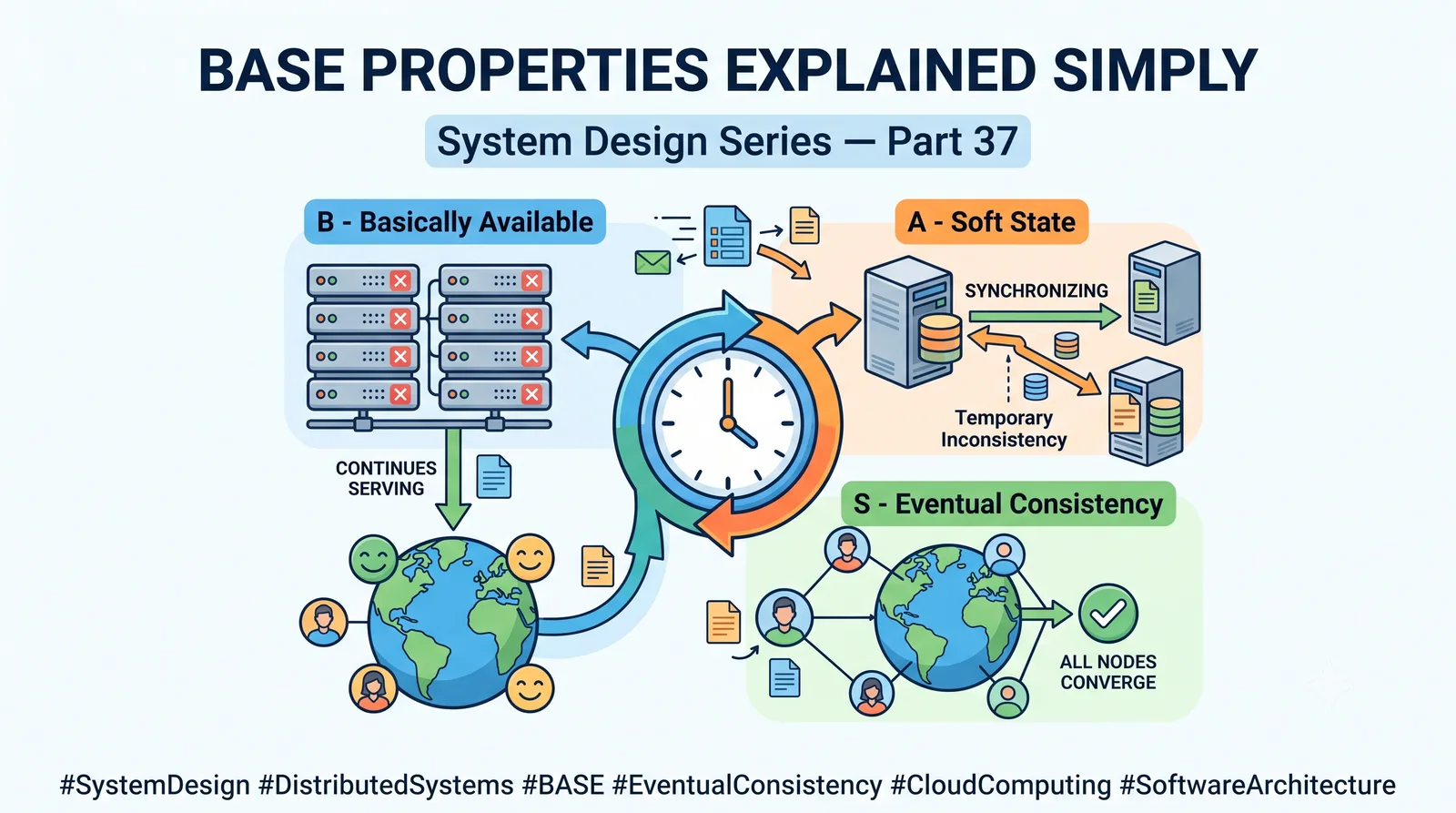
B — Basically Available
A — Soft State
S — Eventual Consistency
Instead of guaranteeing immediate consistency like ACID, BASE guarantees that the system remains available and eventually becomes consistent.
1. Basically Available
The system continues serving requests even if some servers are unavailable.
Example:
An e-commerce website has ten servers.
Two servers fail.
Customers can still browse products and place orders.
The system remains operational instead of going offline.
Availability comes first.
2. Soft State
The system's data may temporarily change even without new user actions.
Why?
Because updates continue propagating between distributed nodes.
Different servers may hold slightly different values for a short period.
This temporary inconsistency is expected.
3. Eventual Consistency
This is the heart of BASE.
Data may not be identical across all servers immediately.
But given enough time—and no new updates—all replicas converge to the same value.
Eventually...
every user sees the same data.
Real-World Example: Social Media
You upload a new profile picture.
Users in India may see it instantly.
Users in Europe might still see the old picture for a few seconds.
After replication completes,
everyone sees the latest image.
That's eventual consistency.
Another Example: Amazon Product Reviews
You submit a review.
It appears immediately in one region.
Another region may display it a few seconds later.
The review isn't lost.
It simply hasn't propagated everywhere yet.
How BASE Works
User updates data.
↓
One server accepts the request.
↓
The update is replicated to other servers.
↓
Other replicas synchronize asynchronously.
↓
Eventually,
all replicas contain the same data.
Why BASE Matters
Large internet-scale systems need to:
-
Handle millions of users
-
Survive server failures
-
Scale across multiple regions
-
Respond quickly
Waiting for every database replica to synchronize before answering every request would reduce performance.
BASE solves this by prioritizing availability and scalability.
Production Architecture
A typical BASE-based architecture looks like this:
User
↓
Load Balancer
↓
Application Servers
↓
Primary Database
↓
Asynchronous Replication
↓
Distributed Replicas
↓
Eventually Consistent Data
This model enables global applications to remain fast and resilient.
Where BASE is Commonly Used
Many distributed databases and cloud-native systems embrace BASE principles, including:
-
Cassandra
-
DynamoDB
-
Couchbase
-
Riak
These systems are designed for high availability and horizontal scalability.
Advantages
✔ High availability
✔ Excellent horizontal scalability
✔ Better fault tolerance
✔ Fast response times
✔ Supports global applications
✔ Handles massive traffic efficiently
Challenges
Temporary Inconsistency
Different users may briefly see different versions of the same data.
More Complex Application Logic
Applications may need to handle stale reads or resolve conflicts when updates occur simultaneously.
Not Suitable for Financial Transactions
Critical operations such as banking, payroll, or stock trading typically require stronger consistency guarantees than BASE provides.
BASE vs ACID
| ACID | BASE |
|---|---|
| Strong consistency | Eventual consistency |
| All-or-nothing transactions | High availability |
| Best for banking and finance | Best for internet-scale systems |
| Immediate consistency | Temporary inconsistency is acceptable |
| Prioritizes correctness | Prioritizes scalability and availability |
Production-Level Insight
Many modern architectures combine both models.
For example:
-
Payment processing uses ACID transactions.
-
Product recommendations use BASE.
-
User likes, comments, notifications, and analytics often use BASE.
Choosing the right consistency model depends on the business requirement—not on which model is "better."
Interview Tip
A common System Design interview question is:
"What is the difference between ACID and BASE?"
A strong answer should explain:
-
ACID guarantees immediate consistency and reliable transactions.
-
BASE prioritizes availability and scalability while accepting eventual consistency.
-
Real-world systems frequently use both, depending on the workload.
Key Takeaways
✔ BASE stands for Basically Available, Soft State, and Eventual Consistency.
✔ It prioritizes availability and scalability over immediate consistency.
✔ Temporary inconsistency is expected in distributed systems.
✔ Eventual consistency ensures all replicas synchronize over time.
✔ BASE powers many cloud-native and globally distributed applications.
✔ Large-scale systems often combine ACID and BASE where each fits best.
One of the biggest lessons in System Design is this:
There is no universal database strategy.
The best architectures balance consistency, availability, performance, and scalability based on the needs of the business.
Understanding BASE helps you design systems that continue serving millions of users—even when parts of the infrastructure fail.
This is Part 37 of the System Design Simplified series.
Next Article: Part 38 — ACID vs BASE: Which One Should You Choose?
#SystemDesign #DistributedSystems #BASE #EventualConsistency #CloudComputing #SoftwareArchitecture #BackendDevelopment #DatabaseDesign #Scalability #Microservices #SystemDesignInterview #SoftwareEngineering #NoSQL #TechArchitecture
