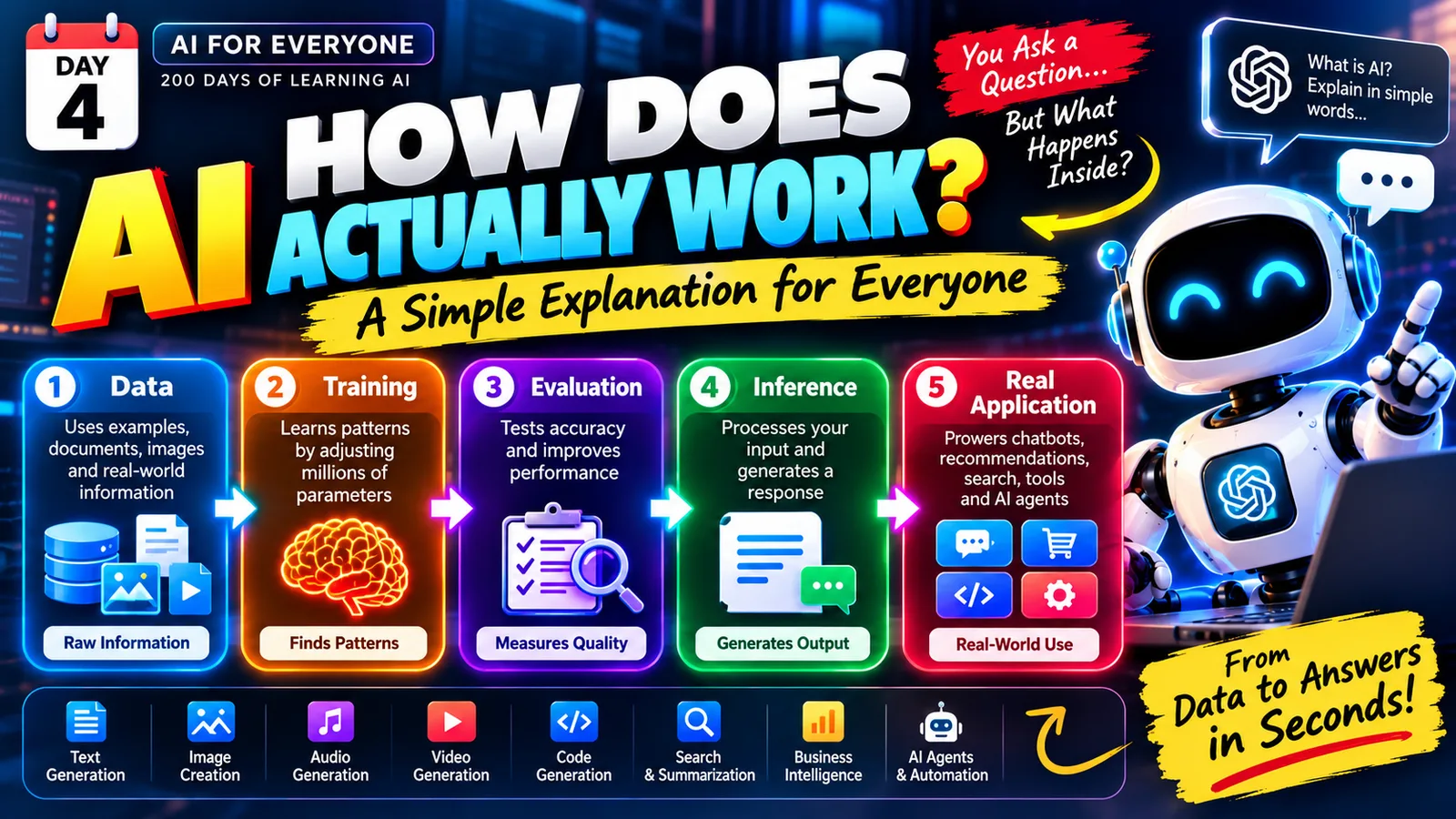
AI for Everyone — Day 4 of 200
Introduction: What Happens When You Ask AI a Question?
You open ChatGPT and type:
"Explain artificial intelligence to a beginner using a simple example."
Within seconds, you receive a detailed answer.
But have you ever wondered what happens between submitting your question and receiving that response?
How does a computer process your words? How does it generate an answer? Does it search the internet every time? Does it think like a human? And why can it sometimes provide incorrect information with complete confidence?
These questions help us understand one of today's most important technologies.
Artificial intelligence is not a single tool or algorithm. It is a broad field involving different methods for recognizing patterns, making predictions, generating content, and solving problems.
The good news is that you do not need an advanced mathematics degree to understand the fundamentals.
In this guide, we'll explain how AI works step by step using simple analogies, practical examples, and real-world applications.
Whether you are a student, professional, business owner, or software developer, this article will help you understand what happens behind the scenes.
1. What Is Artificial Intelligence?
Artificial Intelligence, commonly called AI, is a field of computer science focused on building systems that can perform tasks associated with human-like intelligence.
These tasks can include:
-
Recognizing objects in images.
-
Understanding and generating language.
-
Identifying patterns in data.
-
Making predictions and recommendations.
-
Solving problems.
-
Generating text, images, audio, video, and code.
-
Planning and performing actions through connected tools.
For example, an email application might use AI to identify spam messages. A banking application might use machine learning to flag suspicious transactions. An AI assistant might generate a response to a user's question.
These systems solve different problems, but they share a common goal: using computational methods to perform useful tasks.
It is important to understand that not every AI system works in the same way.
Some systems follow predefined rules. Others learn patterns from data. Modern applications may combine trained models with databases, APIs, search systems, and conventional software.
To understand how AI works, let's examine its main stages.
2. How Does AI Work? The Big Picture
Many AI-powered applications can be understood through six stages.
Stage 1: Data and information
Collect examples, records, documents, images, or other information relevant to the task.
Stage 2: Model training
For systems that learn from data, a training process adjusts the model's internal parameters to improve performance on a defined objective.
Stage 3: Evaluation
Test the model on appropriate examples to understand its accuracy, reliability, and limitations.
Stage 4: Inference
Provide new input to a trained model and obtain a prediction, classification, generated response, or another output.
Stage 5: Application integration
Connect the model to a website, mobile application, API, database, or business workflow.
Stage 6: Monitoring and improvement
Measure real-world performance, investigate failures, and improve the system when necessary.
This is a simplified lifecycle. Not every AI application requires custom model training. Many applications use existing pretrained models, while some systems combine AI with predefined rules and external information sources.
Let's examine each stage.
3. Data: The Foundation of Many AI Systems
Data plays a central role in many AI approaches.
Examples include:
-
Text documents and books.
-
Images and videos.
-
Audio recordings.
-
Customer transactions.
-
Product information.
-
Sensor readings.
-
Historical sales records.
Imagine a company that wants to predict future sales.
It might collect historical sales, product prices, seasonal patterns, promotional activity, and other relevant information.
A machine learning model can use these examples to learn relationships that help it estimate future sales.
However, the quality of the data matters.
If the historical records contain errors, exclude important information, or no longer reflect current business conditions, the resulting predictions may be unreliable.
A simple analogy: Learning to recognize ripe mangoes
Imagine learning to identify ripe mangoes.
You examine different mangoes and observe their color, texture, smell, and firmness. Over time, you develop a sense of which mangoes are likely to be ripe.
A machine learning model follows a computational learning process, using the data and learning method provided to it.
The analogy has limits: AI does not automatically gain human sensory experience or understanding simply because it learns patterns.
The key lesson: Data helps many AI models learn useful patterns, but more data does not automatically mean better AI. Quality, relevance, representation, and suitability for the task are also important.
4. Training: How AI Models Learn Patterns
Training is the process through which a model's parameters are adjusted to improve performance on a particular learning objective.
Consider a model designed to predict house prices.
The training dataset might include:
-
House size.
-
Location.
-
Number of bedrooms.
-
Property age.
-
Historical sale price.
During training, a learning algorithm adjusts the model's parameters to reduce the difference between its predictions and the target values, according to a chosen loss function.
After training, the model may learn useful relationships between property characteristics and prices.
It can then estimate the price of a house it has not seen before.
That estimate might be useful, but it is not guaranteed to be correct.
What are model parameters?
Model parameters are internal numerical values learned during training.
In a neural network, these include weights and biases. Their values influence how the network transforms input into output.
Large language models contain many learned parameters that influence how they process text and generate responses.
Developers generally do not manually set every parameter. Instead, training algorithms adjust them according to the model architecture, training data, and learning objective.
Does every AI system need training?
No.
A rule-based system can operate using explicitly programmed conditions. An application using a pretrained language model can perform useful tasks without training a new model.
This distinction is important because building an AI application and training an AI model are two different activities.
A developer might build a sophisticated AI-powered application by integrating an existing model with APIs, databases, retrieval, security controls, and business logic.
5. Evaluation: How Do We Know Whether AI Works?
A model that performs well on its training data may still perform poorly on new examples.
This is why evaluation is essential.
Suppose you train a model to classify spam emails.
You should not judge its quality only by checking emails it has already learned from. You should also evaluate it on appropriate examples that were held out from training.
Depending on the problem, evaluation metrics may include:
-
Accuracy.
-
Precision and recall.
-
F1 score.
-
Mean absolute error.
-
Response latency.
-
Cost per request.
-
Task-specific quality measures.
The right metric depends on the use case.
For example, in fraud detection, missing a genuinely fraudulent transaction may have a different cost from incorrectly flagging a legitimate purchase.
AI applications also require testing beyond the initial model evaluation. Real-world performance can change as user behavior, business conditions, and input data evolve.
The key lesson: A model should be evaluated against the requirements of its intended use, not simply because it produces plausible-looking output.
6. Inference: How AI Produces an Output
Inference is the process of using a trained model to process new input and produce an output.
For example:
-
A spam classifier receives an email and predicts whether it is spam.
-
An image model receives a photograph and identifies objects.
-
A forecasting model receives business data and estimates future sales.
-
A language model receives a prompt and generates a response.
Consider the question:
"What is machine learning?"
A language model processes the input using its learned parameters and the context available to it, then generates a sequence of output tokens.
Those tokens are converted into readable text.
The model is not necessarily retrieving a fixed answer stored in a database. It generates a response using patterns learned during training and information available at runtime.
However, an AI application can also use search, databases, or external tools to retrieve information before generating a response.
This explains why two applications can answer the same question differently. They may use different models, instructions, context, retrieval sources, or generation settings.
7. How Does ChatGPT Generate Answers?
Modern language models use a process involving tokenization, neural network computation, and token generation.
Here is a simplified explanation.
Step 1: You enter a prompt
For example:
"Explain cloud computing using a real-world analogy."
The prompt provides the task and context for the model's response.
Step 2: The text is converted into tokens
A token is a unit of text processed by the model. It may represent a word, part of a word, punctuation, or another text unit.
Tokenization converts the input into a representation the model can process.
Step 3: The model processes the context
The model uses its neural network and learned parameters to process the input.
Modern language models commonly use Transformer architectures. Their attention mechanisms help represent relationships between different parts of the input.
Step 4: The model generates output tokens
An autoregressive language model typically predicts a probability distribution over possible next tokens and generates a token according to its decoding strategy.
This process repeats as additional tokens are produced.
Step 5: The response is returned
The generated tokens are converted into readable text and displayed to the user.
Some AI applications also perform additional operations, such as retrieving documents, calling tools, applying safety checks, or validating structured outputs.
An everyday analogy: Writing one piece at a time
Imagine someone writing a sentence and repeatedly deciding which word or phrase should come next.
A language model performs a computational process related to next-token prediction, using the current context and learned statistical relationships.
However, it is not simply searching a dictionary for the next word. Nor does next-token prediction guarantee factual accuracy or human-like understanding.
8. Does AI Search the Internet for Every Answer?
No.
A language model can generate an answer using patterns learned during training and the context supplied in the current interaction.
Depending on the application, it may also use web search, document retrieval, databases, or external APIs.
These are different mechanisms.
Scenario A: Answering from the model
You ask:
"What is a database index?"
A language model may generate an explanation based on patterns learned during training.
Scenario B: Retrieving current information
You ask:
"What is the latest version of a software framework?"
An application with access to a reliable, up-to-date source can retrieve current information and use it to generate an answer.
Scenario C: Answering from private company documents
You ask:
"What is our company's leave policy?"
An enterprise AI application may search authorized company documents, retrieve relevant passages, and use those passages to generate an answer.
The model cannot automatically access every private company document merely because it can generate language.
The takeaway: A model's learned knowledge, the current conversation, and externally retrieved information are different sources of context.
Understanding that distinction helps explain why some AI answers are current and grounded while others may be incomplete or outdated.
9. How Does AI Learn Without Memorizing Everything?
Ideally, a machine learning model learns patterns that generalize to new examples rather than simply memorizing its training data.
Consider the house-price example again.
A useful model should learn relationships between property features and prices that apply to unseen houses within an appropriate range of conditions.
If the model memorizes training examples and performs poorly on new houses, it has not learned a sufficiently generalizable pattern.
This problem is related to overfitting.
Overfitting occurs when a model fits its training data too closely and performs poorly on new data.
Developers use techniques such as suitable data splitting, regularization, model selection, and careful evaluation to reduce this risk.
For large language models, training is much more complex than the house-price example, but the distinction between learned patterns and reliable generalization remains important.
10. Why Does AI Sometimes Give Wrong Answers?
AI systems can make mistakes for several reasons.
1. Incomplete or unsuitable data
The model may not have learned useful patterns for a particular situation.
2. Ambiguous instructions
If a prompt is unclear, the model may interpret it differently from what the user intended.
3. Missing context
The model may not have the information needed to produce a reliable answer.
4. Outdated information
A model may lack recent facts unless the application supplies updated information.
5. Hallucinations
Generative AI can produce plausible-sounding statements that are false or unsupported.
6. Weak application design
An application may fail to validate outputs, retrieve relevant documents, handle errors, or restrict inappropriate actions.
How can we reduce these errors?
Depending on the use case, practical measures include:
-
Providing clear instructions and relevant context.
-
Retrieving reliable source material.
-
Validating outputs against schemas or business rules.
-
Testing with representative examples.
-
Monitoring failures and user feedback.
-
Requiring human review for high-impact decisions.
No single technique eliminates every error. Reliable AI depends on model quality, system design, testing, and appropriate oversight.
11. A Real-World Example: An AI Shopping Assistant
Imagine a customer visiting an online shopping website and asking:
"Find a lightweight laptop under ₹60,000 for programming."
How could an AI-powered application handle this request?
Step 1: Understand the request
A language model interprets the customer's requirements, including the budget, intended use, and preference for a lightweight laptop.
Step 2: Retrieve product information
The application queries its product catalog for available laptops and their verified prices and specifications.
Step 3: Apply filters and business rules
The application checks the budget, availability, and other required constraints.
Step 4: Generate a response
The language model explains the matching products using the retrieved information.
Step 5: Present the results
The application displays relevant products and allows the customer to inspect their specifications.
Notice that the language model does not need to invent a product catalog.
The application retrieves real product information and uses conventional software to enforce business constraints.
The model provides a natural-language interface, while the database and application logic supply facts and control the workflow.
This is an example of combining AI with traditional software engineering.
12. Training vs. Inference: What Is the Difference?
These terms are fundamental to understanding AI.
| Training | Inference |
|---|---|
| The model learns by adjusting its parameters. | A trained model processes new input. |
| Uses a learning objective and training data. | Uses input, learned parameters, and available context. |
| Can require substantial computational resources. | Resource requirements depend on the model and workload. |
| Produces a trained model or updated parameters. | Produces a prediction, classification, or generated response. |
| Example: Training a model to classify images. | Example: Using the model to classify a new image. |
A common misconception is that every question you ask an AI assistant retrains the underlying model.
In ordinary use, the model generates responses through inference. The conversation may provide additional context for the current interaction, but that does not mean the model's underlying parameters are automatically updated after every question.
Some systems have separate learning or memory mechanisms, but these should not be confused with retraining the model itself.
13. Do You Need to Train Your Own AI Model?
Usually, not as your first step.
If you want to build an AI-powered application, you can often start by integrating a pretrained model through an API or using an existing model that fits your requirements.
For example, you might build:
-
A document summarization application.
-
A customer-support assistant.
-
A natural-language interface for business data.
-
A code explanation tool.
-
A document question-answering system.
These applications can combine an existing model with application logic, retrieval, databases, and access controls.
Custom model training or fine-tuning may be appropriate when you have a clear requirement that cannot be met adequately through prompting, retrieval, configuration, or other simpler methods.
Your decision should consider quality, data availability, privacy, cost, latency, maintenance, and operational complexity.
Start with the simplest approach that meets your requirements. Add complexity only when you have evidence that it is needed.
14. What Should Beginners Learn Next?
Now that you understand the basic AI workflow, here is a practical learning path.
Step 1: AI fundamentals
Learn the difference between AI, Machine Learning, Deep Learning, and Generative AI.
Step 2: Model basics
Understand training, inference, tokens, parameters, and the role of data.
Step 3: Prompting and model APIs
Learn how to provide instructions, manage context, and integrate models into applications.
Step 4: Retrieval-Augmented Generation (RAG)
Explore how AI applications retrieve information from approved documents and databases to support grounded responses.
Step 5: AI agents and tool calling
Learn how models can interact with APIs and coordinate multi-step workflows under controlled permissions.
Step 6: Production AI engineering
Explore evaluation, observability, security, latency, cost optimization, and human oversight.
If you are a developer, you can practice these skills using your existing technology stack, whether that is .NET and C#, Node.js, or another suitable platform.
The objective is not merely to make an AI demo work once. It is to understand how to build a system that behaves reliably under realistic conditions.
15. Final Takeaways
Let's recap the most important concepts.
-
AI is a broad field, and different systems use different approaches.
-
Data helps many AI models learn patterns, but quality and relevance matter.
-
Training adjusts model parameters; inference uses the trained model to produce outputs.
-
Generative AI can create useful content but can also produce false information.
-
Not every AI application needs a custom-trained model.
-
Real applications often combine models, databases, APIs, conventional software, and security controls.
-
Testing, monitoring, and verification are essential for reliable AI systems.
The most important lesson is simple:
Understanding how AI works helps you move beyond using AI tools to evaluating, integrating, and building AI-powered solutions.
You do not need to understand every mathematical detail before you begin. Start with the concepts, experiment with real applications, and deepen your knowledge step by step.
Frequently Asked Questions
Does AI think like a human?
AI can perform tasks that resemble aspects of human intelligence, but that does not establish that it thinks, experiences, or understands the world as humans do. Different systems have different capabilities and limitations.
Does AI learn every time I ask a question?
Usually, the underlying model parameters are not updated simply because you submit a question. The model performs inference using its learned parameters and the context available to it.
Why does AI sometimes make mistakes?
Models can lack relevant information, misinterpret instructions, generalize poorly, or generate unsupported statements. Reliable applications need suitable data, evaluation, verification, and appropriate controls.
Can I build an AI application without training a model?
Yes. Many applications use pretrained models through APIs or existing model deployments, then integrate them with databases, APIs, retrieval, and business logic.
What is the difference between AI and automation?
Traditional automation often follows predefined workflows and rules. AI can add capabilities such as classification, prediction, language processing, and content generation. Many modern workflows combine both.
Continue the AI for Everyone Series
This article is Day 4 of the 200-Day AI for Everyone Series.
The next article is:
Day 5 — What Is Machine Learning? How Machines Learn From Data
We'll explore how models learn patterns, the different types of Machine Learning, and practical examples from everyday applications.
Explore more technology resources
Visit Toolliyo for developer resources, tutorials, and practical technology content.
Get personalized career mentorship
For resume reviews, LinkedIn optimization, interview preparation, and career guidance, connect through Topmate.
Follow the series to build your understanding of AI, from the fundamentals to real-world AI engineering.
Learn AI. Understand AI. Build with AI.
#ArtificialIntelligence #GenerativeAI #MachineLearning #AIForEveryone