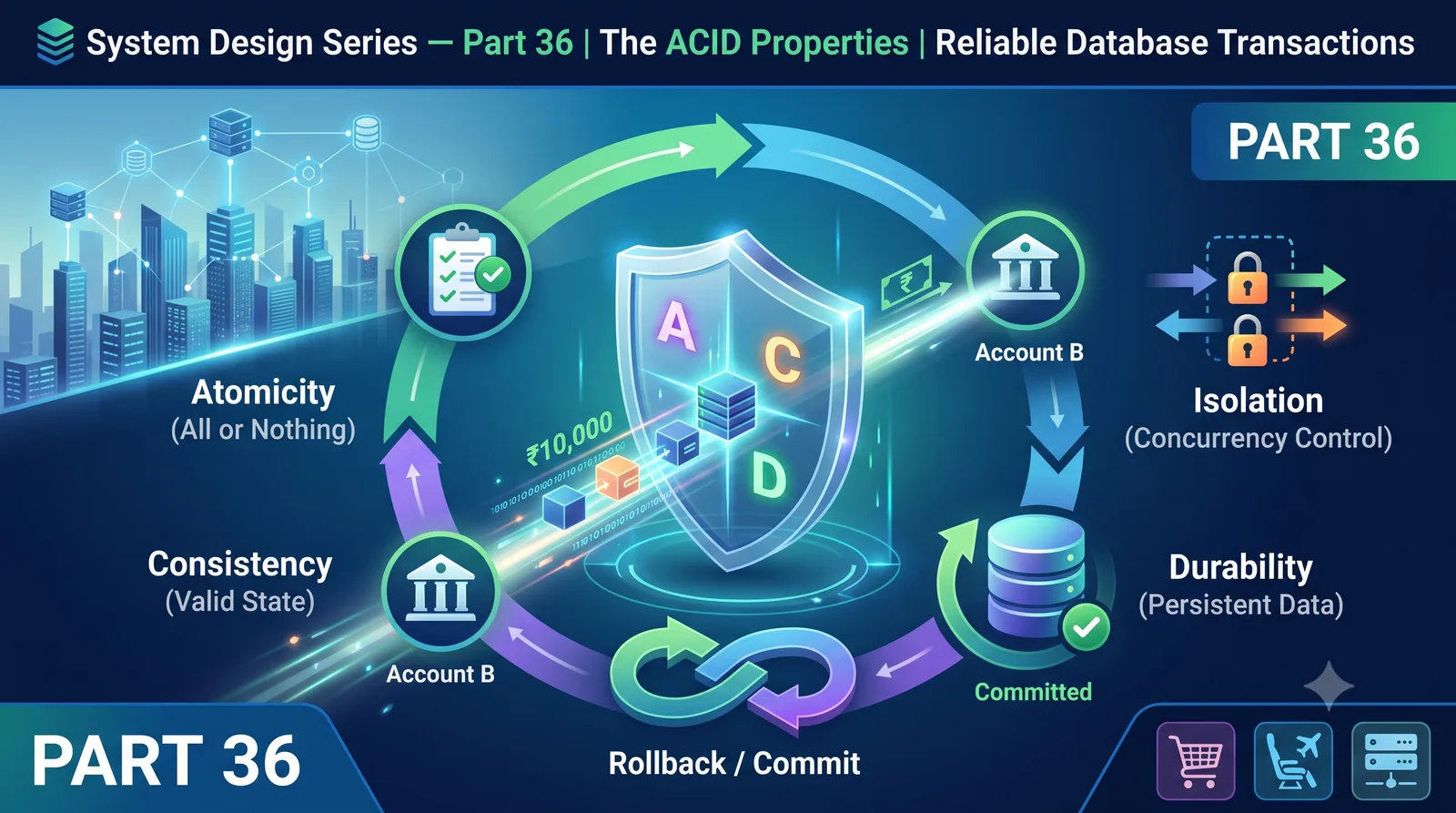
ACID Properties Explained Simply
System Design Series — Part 36
Imagine you're transferring ₹10,000 from your bank account to your friend's account.
The process looks simple.
Your account balance decreases.
Your friend's balance increases.
Now imagine something goes wrong halfway through.
Your account is debited.
But your friend's account is never credited because the database crashed.
The money disappears.
This would be a disaster.
So how do banking systems prevent this?
How do companies like Amazon, PayPal, Visa, and Google Pay ensure that critical transactions never leave the database in an inconsistent state?
The answer lies in the ACID Properties.
Every backend developer and software architect should understand these four principles because they are the foundation of reliable database transactions.
Let's understand them in the simplest way possible.
The Real Problem
Imagine you're booking a flight.
The last available seat is left.
At exactly the same moment,
two customers click:
"Book Now."
Without proper transaction handling,
both users could purchase the same seat.
Now the airline has sold one seat twice.
This is called data inconsistency.
Production databases must prevent situations like this.
That's exactly why ACID exists.
A Simple Real-World Analogy
Imagine writing an important exam.
You answer every question.
Only after completing the exam do you submit your answer sheet.
The teacher accepts either:
✔ The entire answer sheet
or
✔ Nothing at all.
They don't accept only half of your answers.
Database transactions work in the same way.
They either complete successfully,
or they don't happen at all.
What is ACID?
ACID is a set of four properties that ensure database transactions are:
-
Reliable
-
Accurate
-
Consistent
-
Safe
ACID stands for:
A — Atomicity
C — Consistency
I — Isolation
D — Durability
Together, these properties protect data even when failures occur.
What is a Transaction?
A transaction is a group of database operations treated as a single unit of work.
Example:
Transfer Money
↓
Debit Account A
↓
Credit Account B
↓
Commit Transaction
If any step fails,
the entire transaction is rolled back.
1. Atomicity
Atomicity means:
"All or Nothing."
Either every operation succeeds,
or none of them do.
Example:
Transfer ₹10,000.
Step 1
Debit Account A.
✔ Success
Step 2
Credit Account B.
❌ Failed
Without Atomicity:
Money disappears.
With Atomicity:
The first operation is rolled back.
The database returns to its original state.
No money is lost.
2. Consistency
Consistency ensures that every transaction moves the database from one valid state to another.
Business rules must always remain true.
Example:
A bank account cannot have negative money if overdrafts aren't allowed.
A product's inventory cannot become less than zero.
Consistency guarantees that invalid data never enters the database.
3. Isolation
Imagine two customers purchasing the last concert ticket.
Without Isolation:
Both transactions read the same inventory.
Both complete successfully.
One ticket is sold twice.
Isolation prevents this.
Transactions behave as if they are running one at a time,
even when many users access the database simultaneously.
This protects data from concurrency issues.
4. Durability
Suppose a payment is completed successfully.
Immediately after that,
the database server loses power.
Should the payment disappear?
Absolutely not.
Durability guarantees that once a transaction is committed,
it is permanently stored.
Even after:
-
Server crashes
-
Power failures
-
System restarts
the committed data remains safe.
How ACID Works
Step 1
Transaction begins.
↓
Step 2
Database validates the request.
↓
Step 3
Operations execute.
↓
Step 4
If everything succeeds,
Commit.
↓
Otherwise,
Rollback.
This ensures data integrity.
Real-World Example: Banking
Transfer ₹10,000.
Database executes:
Debit Sender.
↓
Credit Receiver.
↓
Commit.
If the Credit operation fails,
Rollback.
The sender's balance is restored automatically.
That's ACID in action.
Another Example: Amazon
Imagine purchasing the last PlayStation.
The database must:
-
Reduce inventory
-
Create order
-
Record payment
-
Generate invoice
If invoice generation fails,
the transaction should not leave inventory reduced without an order.
Everything succeeds together,
or everything is rolled back.
Why ACID Matters
Without ACID,
applications may experience:
❌ Duplicate orders
❌ Missing payments
❌ Incorrect inventory
❌ Corrupted financial records
❌ Lost transactions
ACID ensures data remains trustworthy.
Production Architecture
A typical transactional flow looks like this:
User
↓
Application
↓
Database Transaction
↓
Validate
↓
Commit
or
Rollback
↓
Response
Every financial or business-critical operation follows this pattern.
Databases That Support ACID
Popular relational databases provide strong ACID guarantees.
Examples include:
-
SQL Server
-
PostgreSQL
-
MySQL (InnoDB)
-
Oracle
Many NoSQL databases now support transactions as well,
but implementation details vary.
Advantages of ACID
✔ Reliable transactions
✔ Strong data consistency
✔ Safe concurrent operations
✔ Recovery from failures
✔ Trusted financial systems
✔ Better data integrity
Challenges
Performance
Strong transaction guarantees require additional processing.
This may reduce throughput in extremely large distributed systems.
Scalability
Maintaining ACID across globally distributed databases can be complex.
Some large-scale NoSQL systems choose different trade-offs to improve availability and scalability.
Common Developer Mistakes
Ignoring Transactions
Updating multiple tables without a transaction can leave the database in an inconsistent state.
Long-Running Transactions
Holding locks for a long time reduces concurrency.
Keep transactions as short as possible.
Forgetting Rollbacks
Always handle failures correctly.
Rollback is just as important as Commit.
Assuming Every Database Behaves the Same
Different databases implement transactions differently.
Understand your database's capabilities.
Production-Level Insight
A common misconception is:
"ACID is only important for banking applications."
Not true.
Any application that manages critical business data benefits from ACID.
Examples include:
-
E-commerce orders
-
Hotel reservations
-
Airline bookings
-
Payroll systems
-
Healthcare records
Whenever accuracy matters,
ACID matters.
Interview Tip
A common System Design interview question is:
"Explain the ACID properties with a real-world example."
A strong answer should explain:
-
Atomicity → All or Nothing
-
Consistency → Valid Data
-
Isolation → Safe Concurrent Transactions
-
Durability → Permanent Storage
Using a banking example makes your explanation much stronger.
Key Takeaways
✔ ACID ensures reliable database transactions
✔ Atomicity means all operations succeed or none do
✔ Consistency keeps data valid before and after every transaction
✔ Isolation prevents concurrent transactions from interfering
✔ Durability guarantees committed data survives failures
✔ ACID is essential for financial and business-critical systems
✔ Transactions protect applications from data corruption
One of the biggest lessons in System Design is this:
Users trust your application because they trust their data.
ACID Properties are one of the main reasons that trust exists.
They ensure that every transaction is complete, accurate, and reliable—even when failures occur.
This is Part 36 of the System Design Simplified series.
Next Article: Part 37 — Database Transactions Explained Simply
If this article helped you understand ACID Properties better, consider sharing it with fellow developers.
#SystemDesign #ACID #DatabaseTransactions #SQL #DatabaseDesign #BackendDevelopment #SoftwareArchitecture #DataConsistency #SoftwareEngineering #SystemDesignInterview #BackendEngineer #SQLServer #PostgreSQL #CloudComputing #TechArchitecture
